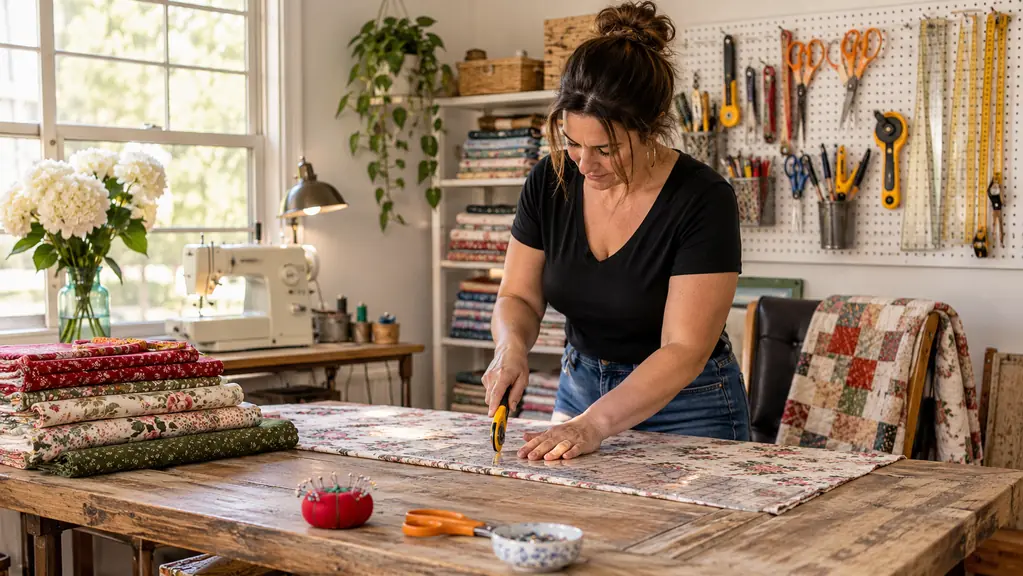
Short answer first, because that is what you came for. If most of your cutting is straight, the OLFA 45mm rotary cutter wins and it is not close. Squaring quilt blocks, slicing binding strips, trimming a stack of charm squares, that is rotary cutter work. If most of your cutting is curved or one-off, a pair of fabric scissors wins for exactly the same reason. Necklines, armholes, notching a seam allowance, clipping a curve you already stitched, that is scissor work. I keep both within arm's reach of the cutting table and I would not part with either one.
I am not neutral about this, so you should know where I sit. I am 74, I ran an alterations counter for 22 years, and my right thumb has opinions about anything that makes it do the squeezing. A cutter with a squeeze trigger spreads the closing across the whole hand, and that one detail is why the OLFA lives on my table instead of in a drawer. The shears still come out every single day. They just do not come out for everything.
| OLFA 45mm Rotary Cutter | Fabric Scissors | |
|---|---|---|
| Straight cuts and strips | Rolls through several layers in one pass, every strip identical | One layer at a time, and long cuts drift |
| Curves and notches | Will follow a gentle curve, awkward below a certain radius | Follows a neckline or armhole by feel, no mat needed |
| Setup before the first cut | Needs a self-healing mat and a clear ruler under it | Pick them up and cut |
| Layers at once | Four to six layers of quilting cotton with a fresh blade | Two at most before the bottom layer creeps |
| Strain on a sore thumb | Squeeze trigger, the whole hand does the closing | Thumb loop takes the pressure on every cut |
| Upkeep | Blade swaps are quick, and a new blade is a purchase | Nothing to replace, though they need sharpening eventually |
| Safety with a cat on the table | Blade is exposed only while you squeeze, then it retracts | Blade stays open between cuts |
| Left-handed sewists | Used the same way, the mat and ruler do the aiming | A left-handed pair does the job, simply harder to find |
| Warranty | Handle is guaranteed forever per the manufacturer | Varies by maker, often nothing past the shop return window |
| Carrying to a class | The mat and ruler have to come too | Goes in a bag on its own |
Read that table top to bottom and you will notice neither column sweeps it. That is the honest answer to the question, and it is the reason this piece is not a straight recommendation. The tool you want depends on which rows match your week.
Where the OLFA Rotary Cutter Wins
Strips. If you have ever cut twenty 2.5 inch binding strips from a yard of fabric with scissors, you know the drift. The first strip is true, the eighth is a quarter inch narrow at one end, and by the twentieth you are re-trimming everything. The OLFA with a clear ruler does not drift, because the ruler is the reference and your hand is only pushing. Line the ruler up once, hold it steady, roll the cutter away from you, and every strip comes out the same width as the one before it. The 45mm blade is the right size for the job. A larger blade is harder to push through a stack and harder to steer, and a smaller one takes two passes where one should do.
What decided it for me was a quilt for my youngest grandchild two winters back. Sixteen fat quarters, and I wanted a hundred and twenty 2.5 inch squares out of them. I cut the first forty with the shears, sitting at the machine because the mat was buried under a pile of mending, and I measured every one of them twice. Two hours, and a dozen of them were off enough that I trimmed them a second time. The remaining eighty took me under thirty minutes on the mat with the ruler, and I did not measure a single square on its own. I laid the ruler, counted off the width, cut, moved, cut. That is the whole argument in one afternoon.
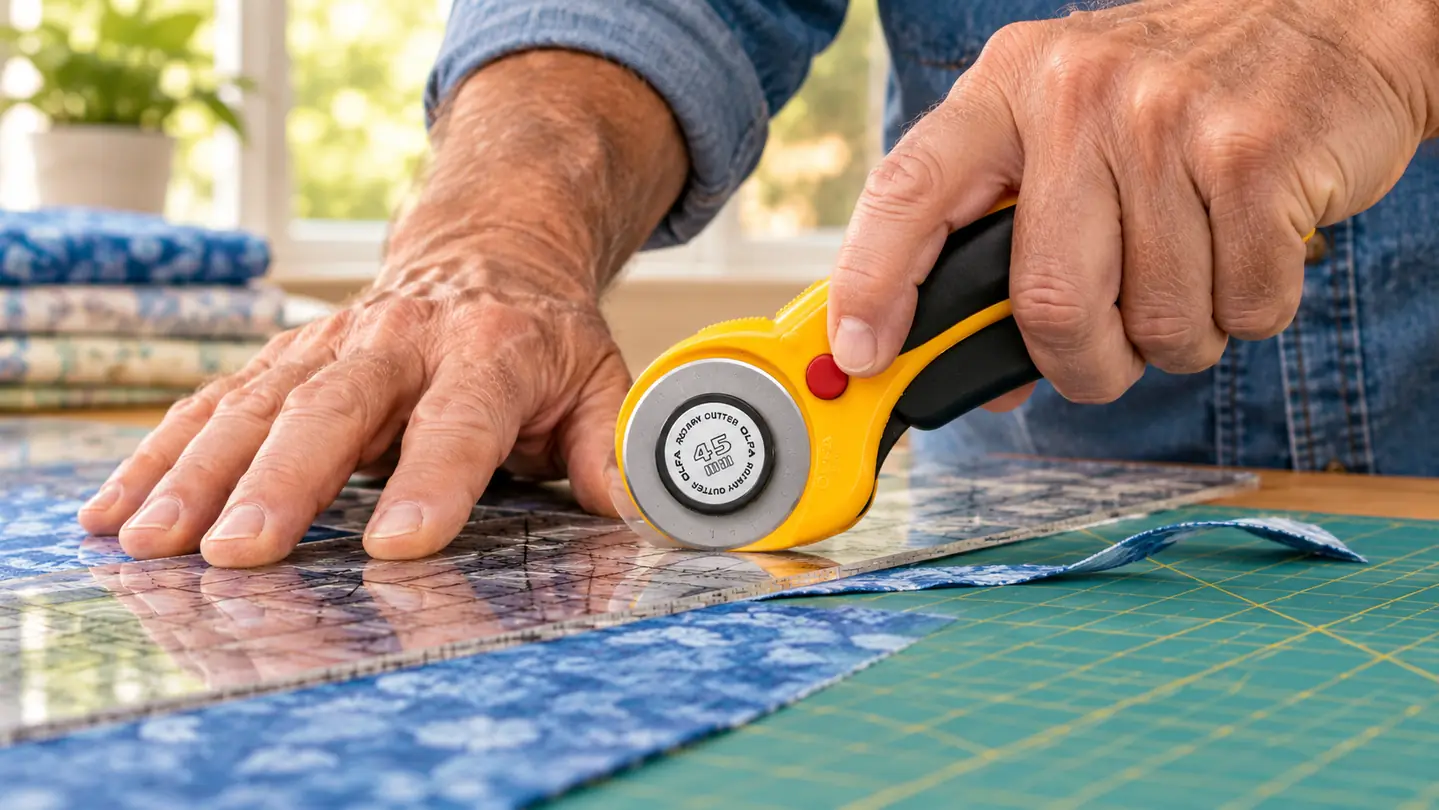
Layers. This cutter goes through four to six layers of quilting cotton in a single pass if the blade is fresh, and that changes how you plan a project. You stop cutting pieces one at a time and start cutting them in stacks, which means a quilt that used to take an afternoon of preparation takes about twenty minutes. The other thing I notice is the thumb. Twenty years of squeezing scissor loops left mine aching in cold weather, and the squeeze trigger here lets the four fingers do the closing while the thumb mostly sits there. At 2.4 ounces the cutter does not tire my wrist either. On a bad day that is the difference between finishing the cutting and putting it off until tomorrow.
Where Fabric Scissors Win
Curves. A rotary cutter can follow a curve, but below a certain radius it becomes a negotiation. You lift, you reposition, you turn the fabric in ways that are not good for accuracy, and you start hoping rather than cutting. Scissors follow a neckline by feel. You cut, you look, you adjust, and the blade goes where your eye goes. Same story with notching. A clip into a seam allowance is a two second job with the tips of a decent pair of shears and a fussy little operation with a rotary blade.
A dress I made for myself last spring is the other half of that story. The bodice had a scooped neckline and a curved armscye, and I did try the rotary cutter on the first muslin. It went fine along the front, where the curve was gentle, and then it went badly at the shoulder, where the radius tightened up and the blade started skipping because I could not turn the fabric fast enough underneath it. I picked up the shears, cut the second muslin in one pass around each armhole, and the difference was visible in the seam when I pressed it open. Curves want a blade that pivots in your hand. A rotary blade pivots on a mat.
No setup, and this is the part people forget while they are shopping. A rotary cutter is half of a system. You need a self-healing mat, you need a clear ruler, and if you are cutting something wider than the mat you slide the whole arrangement along and hope nothing shifts underneath. Scissors need a flat surface and decent light. When I want to hem a pair of trousers on the ironing board by the window, I am not dragging the mat over there. I pick up the shears. For quick jobs, and a mending pile is nothing but quick jobs, that wins outright.
The tool that stopped my thumb from complaining
The OLFA 45mm squeeze-handle cutter is the one I reach for on strips, stacks and anything with a straight edge. The blade retracts the second you let go, which matters more than you would think in a house with a cat who supervises.
Amazon Check Today's Price on Amazon →The Setup Nobody Mentions
Buying the cutter is not the whole purchase, and nobody tells you that at the counter. A rotary cutter wants a mat underneath it and a ruler on top of it. Skip either and you will be disappointed, and you will blame the tool for something the tool did not do. The mat matters because the blade needs something to bite into that is not your good table. The ruler matters because the ruler is what makes the cut straight, not your hand. I have a small mat that lives on the cutting table and a longer ruler for strips, and I have never once regretted putting money into the ruler instead of a second cutter.
The first mat I bought was too small and I did not know enough to care. It was a letter-size mat, and I was cutting strips for a quilt back that ran a good six inches longer than the mat did. So I would cut partway, slide the fabric, and start again, and every slide was a fresh chance for the ruler to creep a sixteenth of an inch out of line. After three strips that were visibly stepped along one edge I understood the problem. Buy the biggest mat your table will hold. Mine covers most of the door-turned-table now, and I have not had a stepped strip since. The mat is not an accessory. It is half the tool.
Blades are the other thing. OLFA ships this one pre-loaded with an RB45-1H Endurance blade, and the swap is simple enough that I can manage it with hands that are not as steady as they used to be. What I did not expect to use is the range of blades that fit the same handle. There is a pinking blade, a scallop and peak blade, and a wave blade, and all three drop into this cutter. I use the pinking blade on felt and on a couple of quilt backs where I wanted a finished edge without binding. That turned one tool into four, which is not something you can say about a pair of shears. The handle is warranted forever according to the manufacturer, which for a rubber-handled tool you squeeze a thousand times a year is worth something.
Four to six layers of quilting cotton in one pass, with the ruler doing the aiming and my thumb doing nothing at all.
How I Actually Use Both
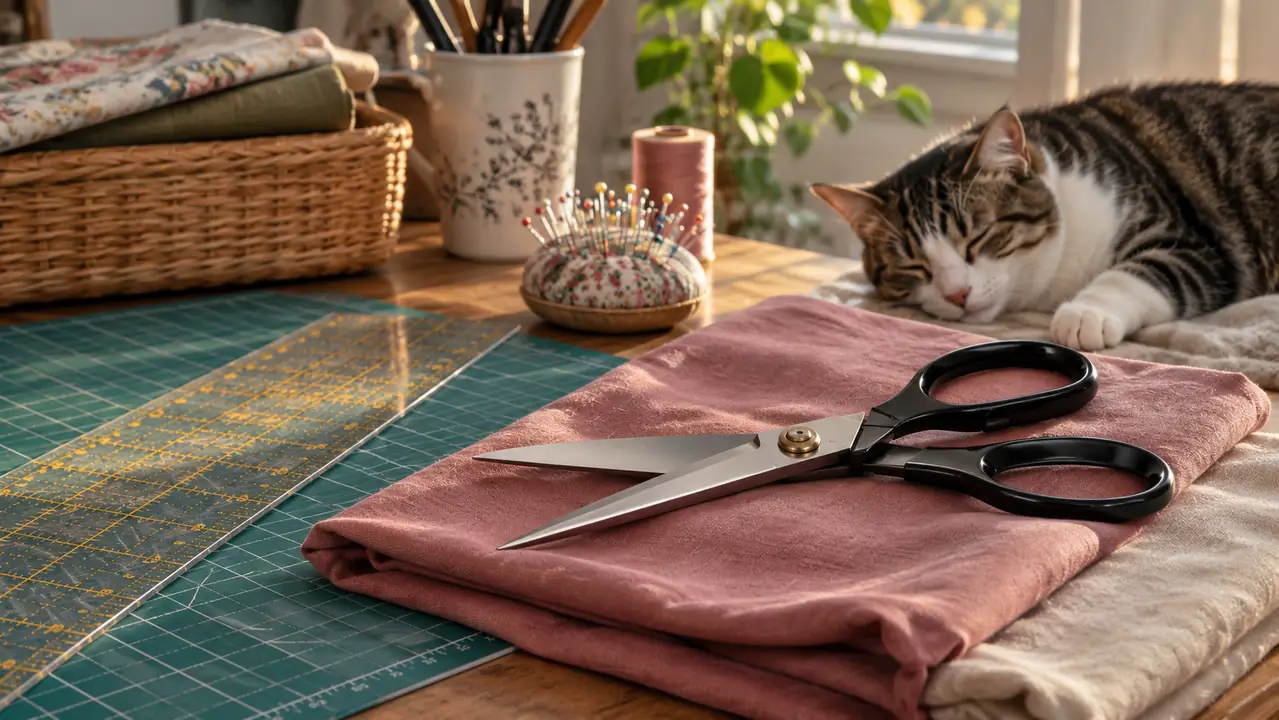
Here is the workflow that settled it for me, and it has not changed in years. Fabric comes off the shelf and goes onto the mat. Everything that needs to be a rectangle happens right there, with the rotary cutter and the ruler. Blocks, borders, binding, backs. Then the pieces go to the machine, and once they are sewn the scissors come out. Trimming seam allowances, clipping curves before turning, notching a collar, cutting a thread. The shears never leave the machine area and the cutter never leaves the mat, and both of them get used every session I sit down.
Tuesday of this week is a fair example. A neighbor brought over two pairs of uniform trousers to shorten, and a block exchange was due at the church on Thursday. I set the trousers on the ironing board, chalked both hems, and cut them with the shears in about four minutes each, standing up, no mat involved. Then I cleared the board, sat down at the table, and cut forty-two 4 inch squares for the exchange with the cutter and the ruler in a little under twenty minutes. Two jobs, two tools, one afternoon, and neither tool ever felt like the wrong one for the work in front of it.
The exception is when a neighbor drops off a pair of trousers to hem. That is a five minute job and the mat stays exactly where it is. I measure, chalk, and cut with the shears on the ironing board, and I am done before it would have taken me to clear the table. My rule, after all these years: the rotary cutter is for making pieces, the scissors are for finishing them. Once I stopped expecting one tool to do both jobs, my cutting got faster and my quilt backs got straighter.
Who Should Buy Which
Buy the OLFA 45mm rotary cutter if you cut straight lines more than once a month and you own, or are willing to own, a mat and a ruler. Quilters, bag makers, anyone doing repetitive strip cutting, anyone whose thumb complains after a long session. The rubber handle and the light weight mean you can cut for an hour without your hand cramping, and the retracting blade is a real comfort in a small room where the cat insists on lying across your work. It is also the tool to buy if you want decorative edges later, since the pinking, scallop and wave blades all fit the same handle.
Stick with fabric scissors if your sewing is mostly alterations and repairs. If you hem, mend, take in and let out, you are doing curved one-off cutting all day long, and a rotary cutter will feel like a second job you did not ask for. Shears also make more sense if you sew in a shared space and cannot leave a mat set up between sessions, or if you carry your work to a class. And there is nothing wrong with starting where you are. I sewed for years with one good pair of shears and a thimble. The rotary cutter came later, when the cutting got repetitive enough to justify the setup.
If you can only buy one thing this month, buy the shears if you mend and the cutter if you piece. If you piece at all, buy the cutter and the mat together, because a rotary cutter with no mat under it is a good blade wasted.
One handle, four blades, and a thumb that gets to rest
The OLFA RTY-2/DX comes with the RB45-1H Endurance blade loaded, takes the pinking, scallop and wave blades if you want them later, and is warranted forever per the manufacturer. If your cutting has gotten repetitive, this is where to start.
Amazon Check Today's Price on Amazon →