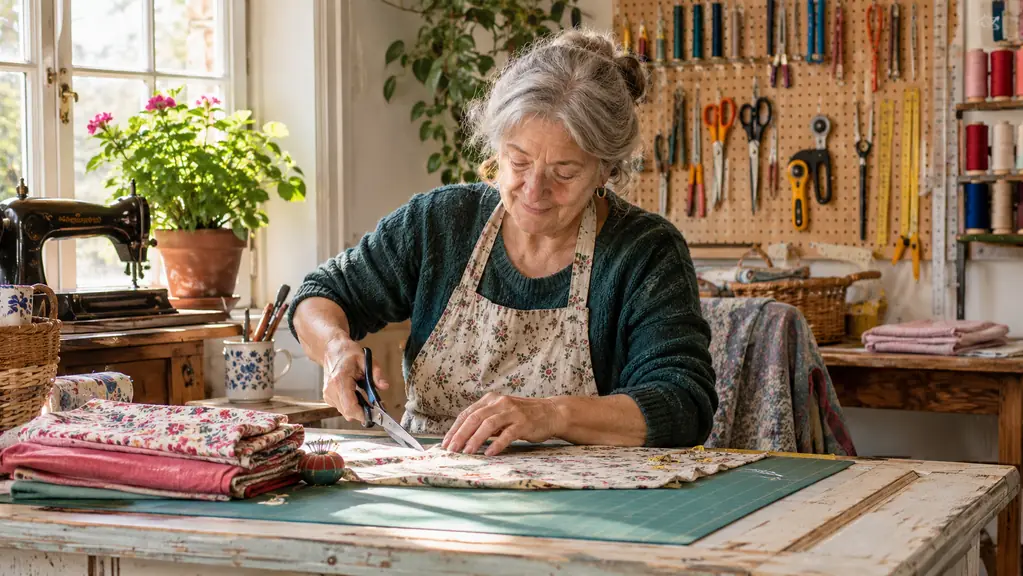
For thirty years I cut fabric with shears, and for the last ten of those years my right thumb complained about it every single time. Arthritis does not care how long you have been sewing. It cares about force, and repetition, and the same closing motion a thousand times a hem. What finally changed things for me was a tool that does not ask your fingers to close against spring tension at all. The OLFA 45mm Ergonomic Squeeze-Handle Rotary Cutter, the RTY-2/DX, runs on a squeeze trigger. Close your hand once and the blade comes out. Let go and it goes away.
What follows is ten reasons it earned a permanent spot on my pegboard, written for anyone whose hands have started to complain louder than their enthusiasm. I have mild arthritis in my right thumb, so I notice grip, weight and force in a way I did not twenty years ago. None of this is about cutting faster. It is about still being able to cut at all on a bad day.
The blade appears when you squeeze and vanishes when you don't
OLFA RTY-2/DX, 45mm, squeeze trigger, self-retracting, 2.4 ounces. Rated 4.7 stars across 9,529 reviews on Amazon.
Amazon Check Today's Price on Amazon →One squeeze opens the blade, one release closes it
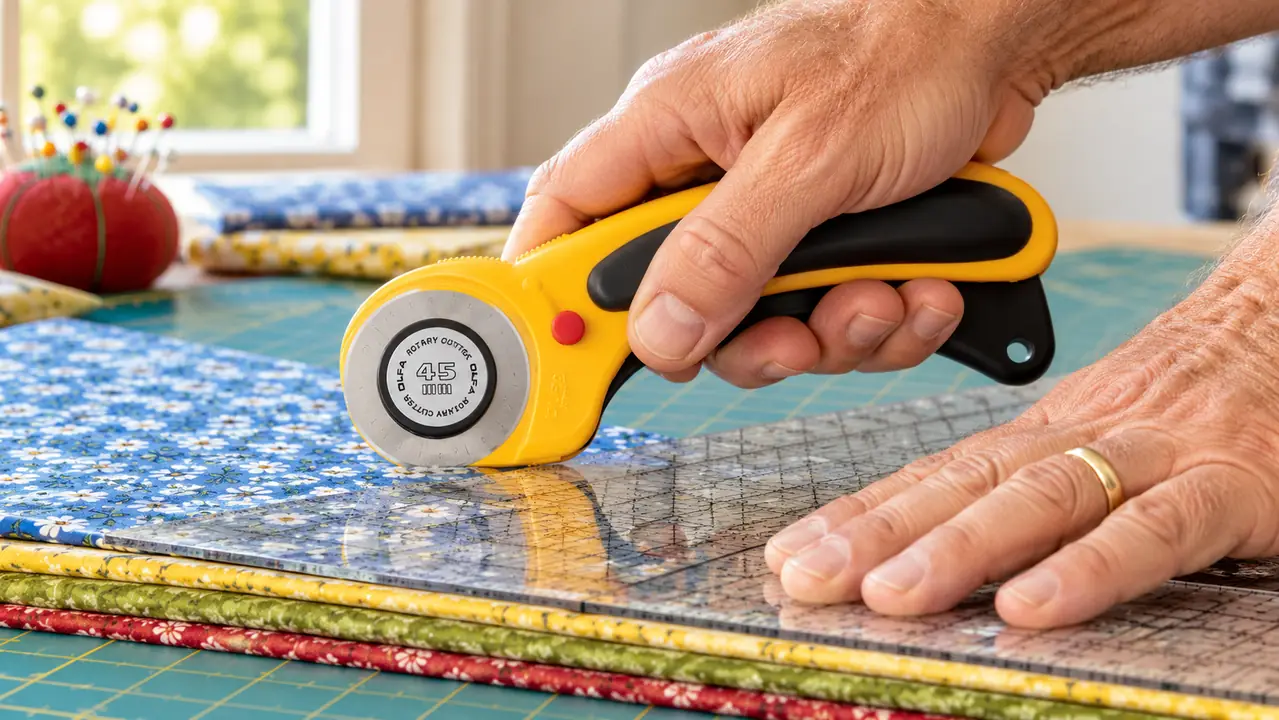
Scissors ask your thumb and fingers to close against spring tension, then open again, then close again. Every cut is a full cycle, and a long strip of binding is hundreds of cycles. The RTY-2/DX works differently. You squeeze the trigger once, the blade comes out, and it stays out for as long as you hold. That is one motion at the start of the cut instead of one motion per inch. When I trim a quilt binding now, my hand makes one decision instead of two hundred.
The blade self-retracts, so you never hunt for a lock
The handle exposes the blade on the squeeze and self-retracts it the instant you let go. That matters for hands that are not quick anymore. I used to set a rotary cutter down with the blade still out, then pat the table looking for it, which is a poor habit to have around a sharp edge. With this one the blade is gone before the tool touches the mat. No lock button to find with a sore thumb, no guard to slide with a fingernail.
2.4 ounces in the hand, not 12
Two point four ounces is the whole cutter. My good shears weigh more than that, and the weight sits further out from my hand, which is where it does the most damage across an afternoon. A light tool held close to the work lets you cut longer before your grip starts to fade. I notice it most on the third or fourth quilt block, the point where I used to start resting my elbow on the table between every cut and pretending I was just thinking.
A rubber handle lets you hold it loosely and still keep control
The handle is rubber, not slick plastic, and that means you can ease off your grip without losing the tool. It sounds like a small thing until you have a thumb that aches, because a sore hand tends to over-grip. It clamps down to protect itself and then aches more for its trouble. A surface with some grip lets you relax. I hold the RTY-2/DX more like a pen than a tool now, the pad of my hand doing the work and my thumb along for the ride.
A 45mm blade goes through four layers in one pass
A 45mm blade cuts through several layers of quilting cotton at once. With shears, four layers means four times the force through the same closing motion, and that is exactly where my thumb used to give out halfway through a stack of squares. With a rotary cutter the layers sit flat on the mat and the blade goes through them together. I cut eight squares at a time now. The same eight used to take me three sittings, with a rest and a cup of tea in the middle of each one.
The fabric stays on the table instead of in the air
Shears lift. To cut with them you raise the fabric off the table, which means holding its weight with one hand while the other one works. A rotary cutter keeps everything flat on the mat. The fabric does not move, your shoulder does not take the load, and your wrist stays in a neutral line instead of twisting around the blade. I did not realize how much of my shoulder ache was really cutting ache until I stopped lifting the fabric for a whole afternoon.
Blade changes are quick, so you actually do them
OLFA builds this cutter so the blade change is simple and safe, and it is. A dull blade is the quiet reason a lot of people give up on rotary cutters. They keep pushing a tired edge, press harder to compensate, and blame their hands. A fresh blade takes the pressure straight back off. Because the swap is quick, I do it. I keep a spare in the drawer and change it the moment the cutter starts to drag rather than waiting for the end of the project.
One handle takes the pinking, scallop and wave blades
The same handle fits OLFA's pinking blade, the scallop and peak blade, and the wave blade. That means the decorative edge work does not need a second tool with a second grip to learn. I do not have to keep three cutters in the drawer and remember which one punishes my thumb least. One handle, one squeeze, and I change the blade to suit the job. For hands with limited strength, fewer tools with different grips is its own kind of relief.
It rolls around curves, so your wrist doesn't twist
A rotary cutter rolls. You push it along the ruler for a straight edge, or walk it around a curve without lifting or turning the fabric. With shears, every change of direction is another squeeze and a reposition of the whole arm, and my right thumb used to pay for every corner of a pattern piece. Now the cutter does the traveling and my hand just steers. Cutting out a dress pattern has gone from an hour with two breaks in it to something I finish standing up.
It stops the cutting stage from being the reason you quit for the day
Here is the honest one. The reason a squeeze-handle cutter is easier on my hands is not any single feature. It is that I stopped dreading the cutting. Cutting used to be the part I put off, because I knew what it would cost me by dinner time. Now I cut first and sew second, the way the pattern instructions always assumed I would. If your hands have started deciding how much you sew, a tool that asks less of them is not a luxury.
When I trim a quilt binding now, my hand makes one decision instead of two hundred.
What I'd Skip
Skip the idea that any rotary cutter will do. The cheap ones with a stiff sliding button and a hard handle are the reason a lot of people decide rotary cutting hurts. You push that button with your thumb before every single cut, which is the exact motion you were trying to avoid in the first place. The squeeze trigger is the whole point of the OLFA RTY-2/DX, and a cutter without it is not solving your problem, it is just moving it.
I would also skip buying it on its own. A rotary cutter on a bare table will wander and dull. The mat and the clear ruler are not accessories, they are part of how the tool works, and a cutter without them will feel like a disappointment. And skip the multi-pack of blades until you know you like the handle. One spare is plenty for a first season. If you are still deciding between this and your shears, that is a fair question and worth sitting with.
Your hands get a vote in this one
45mm squeeze-handle cutter, self-retracting blade, 2.4 ounces, fits the pinking, scallop and wave blades. Rated 4.7 stars by 9,529 Amazon reviewers.
Amazon Check Today's Price on Amazon →