

The first rotary cutter I owned was not an OLFA. It came off a bargain table at a quilt show in Tampa, and it taught me everything I needed to know about why the quilt shops keep the good ones behind the counter. The blade wandered. It skipped where two flannel pieces overlapped. By the third baby quilt I had put it in a drawer and gone back to my shears, and I told myself rotary cutters were a young woman's tool.
I believed that for years. What changed my mind was a neighbor with sixty-four nine-patch squares and one request: could I trim them all to a true six and a half inches? Sixty-four squares with scissors is an afternoon and a sore thumb. So I bought the OLFA 45mm Ergonomic Squeeze-Handle Rotary Cutter, the RTY-2/DX, on the shop owner's word that it was the one she could never keep on the shelf. That was months ago. It has not gone back in the drawer since.
The Quick Verdict
The squeeze trigger is the whole reason to buy it. The self-retracting blade is why I leave it out on the table instead of locking it in a drawer. Months of steady cutting and the only part I have replaced is a blade.
Amazon Check Today's Price →The tool I reach for twenty times an afternoon
45mm blade, squeeze handle, self-retracting, and 2.4 ounces in the hand. It is the one piece of equipment on my cutting table I have never once thought about replacing.
Amazon Check Today's Price on Amazon →How I've Used It
My cutting table is an old door my late husband braced with two-by-fours and topped with a sheet of plywood. It is not pretty, but it is deep and it does not shift when I lean on it. The mat sits on the left third. The rulers hang on the pegboard behind. The cutter lives in the middle, which is where a tool ends up when you reach for it twenty times in an afternoon and cannot be bothered to put it away properly.
Since I bought this one I have cut strip sets for two grandchild quilts, taken up the hems on somewhere near forty pairs of trousers for neighbors, cut out one dress for myself from a rayon that fought me the whole way, and run a good deal of bias binding. That is not a lab test. It is the ordinary work of a woman who sews for other people in a spare bedroom in Lakeland, Florida, with a cat determined to nap on whatever fabric is currently laid out.
What I noticed first was that I stopped dreading the cutting. With shears you walk your hand along the fabric and every inch is a small decision. With a rotary cutter and a good ruler you set up once and push. This one tracks where you point it. Through four layers of quilting cotton it went clean, and the edges came out straight enough that the piecing lined up without me pinching and nudging at the seam line. That is the entire promise of a rotary cutter, and most of the cheap ones break it on the second layer.
Here is a plain example. A neighbor brought over a stack of curtain panels she wanted shortened, four of them, forty-four inches wide and lined. I squared the bottom of the first one with shears and it took me eleven minutes and came out a quarter inch off at the far edge. I laid the second one on the mat, lined the ruler up on the eight-inch mark, and had all four trimmed in about the time the first one took. Same fabric, same afternoon, same woman. The only thing that changed was the tool.
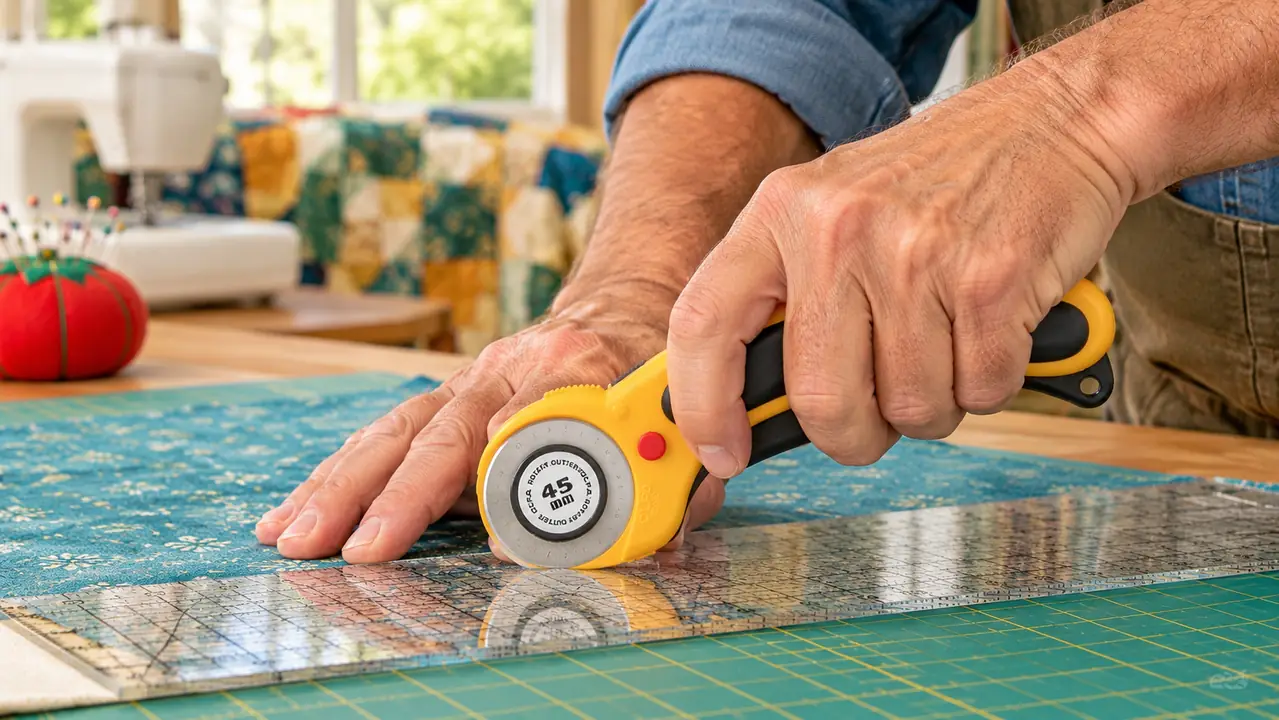
The Squeeze Handle and My Right Thumb
I have arthritis in my right thumb. It is not the worst case anybody has ever had, but it is enough that I notice which tools ask for a pinch and which do not. My old cutter had a slider you pushed up with your thumb and left sitting up. By the end of a cutting session that thumb would be aching and I would be pressing harder than I should, which is exactly when a blade starts to wander.
The RTY-2/DX works differently. You squeeze the handle and the blade comes out. You let go and it pulls itself back in. That sounds like a small thing until you have used it for a whole afternoon. There is no state to remember and no button to check. I set the cutter down on the mat and it is safe. I knock it off the table reaching for the ruler and it is safe. Pockets naps on whatever fabric I have laid out, and I do not have to think about whether the cat is going to find an exposed blade at the edge of the mat.
The trade is that you are squeezing for the length of the cut. On a strip the full width of the table that is a real squeeze, and on a long bias cut I feel it in my forearm by the end. It is still less work than a slider I have to fight, but I want to be honest that it is not free. I cut standing up with my elbow tucked in against my ribs and it is fine. If I had a whole afternoon of cutting ahead of me I would take a break halfway.
I tried to work around it at first. I wrapped the handle in a strip of self-adhesive bandage, thinking a fatter grip would be easier on the thumb, and it was not. It just made the trigger harder to reach and left sticky residue I had to clean off with my thumbnail. Then I moved the mat to the front edge of the door so my forearm could rest on the wood and take some of the load. That did help, and it is free. If you have a bad thumb, start there before you blame the cutter.
The handle is rubber, which matters more than I expected it to. My hand does not slide on it, even in a Florida summer when the air conditioning is losing the argument with the afternoon.
The Blade Does the Work
The cutter arrives loaded with an RB45-1H Endurance blade, 45mm, alloy steel. I am not a metallurgist and I will not pretend to be one. What I can tell you is that 45mm is the right size for the work most of us do at home. It is big enough to go through four layers of cotton with confidence and small enough to turn a gentle curve on a neckline without overshooting into the seam allowance.
Sharpness is the whole game with these tools. A dull rotary blade does not cut, it chews, and chewed fabric frays along the seam allowance and makes a quilt look tired before it has even been quilted. The blade in this one was sharp out of the package and stayed that way through a long stretch of steady work. When it finally started skipping on the bottom layer, I changed it, and the difference was immediate and slightly embarrassing for the amount of complaining I had been doing about my own piecing.
For the record, the first blade lasted me from the nine-patch job through the curtain panels and about half the trousers, which I make somewhere near three months of steady use. When it started skipping I tried the old trick of running it through folded foil to freshen the edge. It bought me one more afternoon and no more. A fresh blade costs less than a ruined quilt top, and I would rather change it than sit there arguing with a tool that has already told me it is finished.
One lesson I have learned the hard way: the blade is only as good as what is under it. A nicked mat will make a brand new blade skip. If your cuts are coming out ragged, run your fingers over the mat before you blame the cutter. I have thrown out a mat that looked perfectly fine and was not.
Sixty-four nine-patch squares trimmed to a true six and a half inches in under twenty minutes, with no ridge where the seams crossed.
Blades That Fit, and Changing Them
The blade change is simple and safe, which is not always true of rotary cutters. It takes about a minute and I did not have to pry at anything or spend the whole time worrying about where my fingers were. The listing says the blade system provides simple and safe blade changes, and I would agree with the wording, which is not something I say often about product copy.
The other reason I stayed with OLFA is that the same handle takes their specialty blades. The pinking blade, the scallop and peak blade, the wave blade. I use the pinking blade on seam allowances for fabric that ravels badly, and I have used the wave blade on a baby quilt binding purely because I liked the look of it. One handle, several blades, one thing to store and one thing to learn.
Blades are the running cost of a rotary cutter, and I would rather buy a good handle once than replace a cheap cutter every year or two. That is the argument for this one, in a sentence. The handle is backed by OLFA's guaranteed forever warranty, which I have never had to test and am glad of.
Where It Fights You
Nothing is perfect and I would not trust a review that told me otherwise.
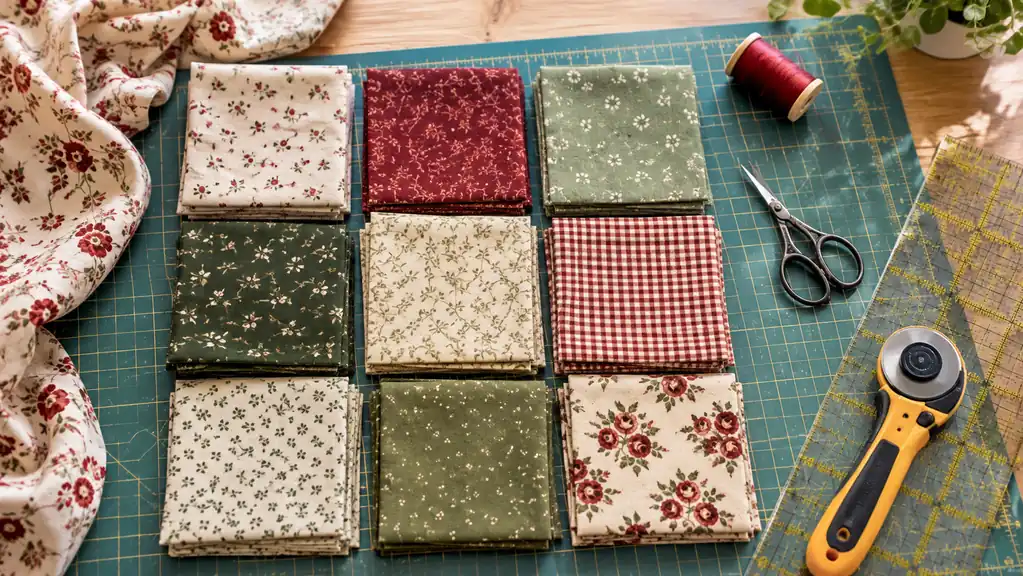
Slippery fabric is the weak spot. Rayon, lining, anything with a slick hand will creep under the ruler and slide ahead of the blade, and no cutter on earth fixes that. You have to weight the ruler, use a fresh blade, and cut one layer at a time. I learned it on the dress and I will not pretend the tool solved it for me. It cut beautifully on the cotton and it needed managing on the rayon, same as every cutter I have ever owned.
I will tell you exactly how that went. The rayon was a dark print, cut on a Sunday afternoon with the window open and the ironing board pushed out of the way. I laid out one layer, weighted the ruler with a tin of buttons at each end, and cut the bodice front. Then I lifted the ruler to cut the back and the fabric had crept an eighth of an inch at the fold. I re-cut it. The second one was straight. The tool did its job both times. The fabric was the problem, and the fabric is always the problem.
The 2.4-ounce weight is lovely in the hand and slightly less lovely when I knock it off the table reaching for a ruler. The auto-retract is both the safety feature and the small annoyance, because the blade is only out while you are squeezing. On very long cuts I set the cutter down between passes and shake my hand out. That is the honest cost of a tool that cannot be left open by accident.
And it is not the cheapest cutter on the shelf. If you cut once a month, you may never notice the difference between this and a lesser tool. I cut most days, for other people, and I notice it every time. That is the dividing line, as plainly as I can put it.
What I Liked
- The squeeze trigger is easier on an arthritic thumb than a slider you push up and leave up
- The blade self-retracts the moment you let go, which matters in a house with a cat and a cluttered table
- The sharp 45mm Endurance blade went through four layers of quilting cotton without wandering
- One handle takes the pinking, scallop and peak, and wave blades as well
- Rubber handle does not slip in a warm room, and 2.4 ounces is light for a long session
- Covered by OLFA's guaranteed forever warranty
Where It Falls Short
- You squeeze for the entire length of the cut, which I feel in my forearm on long bias strips
- No cure for slippery fabric; rayon still creeps unless you weight the ruler
- Costs more than the bargain cutters, and a once-a-month sewist may not notice the difference
- The light weight means it can be knocked off the table
The Rest of the Setup Matters More Than the Tool
I would be doing you a disservice if I let you believe a cutter is the whole answer. The mat, the ruler, and the pressure are the other three legs of the stool.
A mat with a gouge in it will make a good blade skip, and a thin ruler that flexes under your hand will let the blade climb. Buy the thick ruler. Weight it with your spread fingers, not your fingertips. And go easy on the pressure. Push hard and the blade deflects, which is how you get a cut that looks straight until you pick the pieces up and find it is a sixteenth narrow at one end.
Pressing matters too, and it is the step new sewists skip. A seam pressed flat as you go cuts and pieces better than one you press at the end of the project. My rule, after fifty years at this: press as you go, or press twice as long later and be cross about it.
Who This Is For
Home sewists who cut more than once in a blue moon, and who are tired of blaming their own hands for a blade that will not hold a line. Anyone with thumb or hand trouble, because the squeeze is a better motion for a stiff joint than a slider you have to push and leave up. Quilters cutting strips and squares from yardage, and anyone who hems for other people and sets the tool down constantly, which is where the auto-retract earns its keep on its own.
Who Should Skip It
If you cut once a month, a cheaper cutter will do you fine and you will not miss this one. If you want a blade that stays out without a squeeze, this is the wrong design for you and you should say so plainly rather than fight it. And if you are not willing to change a blade when it dulls, no cutter on the market will make you happy, including this one. A dull blade in a good handle is still a dull blade.
Months in, it is still the cutter I reach for first
45mm, squeeze handle, self-retracting blade, and a grip that suits a hand with a bad thumb in it. If you have been cutting with shears and calling it good enough, this is the upgrade that gives you your afternoons back.
Amazon Check Today's Price on Amazon →