It took me about a week to stop reaching for my scissors. That is the honest timeline, and it is the first thing nobody tells you about the OLFA 45mm rotary cutter. You do not become a rotary cutter person the moment you unwrap it. You become one somewhere around day six, when your hand goes to the mat instead of the shears without your brain getting involved.
My name is Winnie Coyle. I am seventy-four, I live in Lakeland, Florida, and I spent twenty-two years behind an alterations counter in a dry cleaner. I have hemmed more trousers than I can count, I quilt for my grandchildren, and my cutting table is an old door my late husband built into a work surface in the spare bedroom. My right thumb has mild arthritis in it, so grip and hand strength are not abstract concerns for me. I have used this OLFA cutter on quilt squares, on neighbor mending, and on one dress I made for myself. What follows is what I found, unflattering parts included.
The Quick Verdict
A well built squeeze-handle cutter with a safety feature that earns its keep every single time you set it down. It rewards practice and punishes rushing, and it is not the tool for someone who wants a perfect straight line on the first afternoon.
Amazon Check Today's Price →Squeeze to cut. Let go and the blade is already gone.
The RTY-2/DX arrives with an RB45-1H Endurance blade loaded, so it is ready the day the box lands. The same handle takes the OLFA pinking, scallop and wave blades later if you want decorative edges.
Amazon Check Today's Price on Amazon →How I've Used It
This cutter has been in the house about eight months. Before that I was a scissors person for fifty years, the good heavy shears, and I did not believe a rolling blade would change anything for me. What changed my mind was a quilt for my youngest granddaughter. Cutting one hundred and twelve squares with shears means lifting and repositioning your hand on every single one, and by about the fortieth square my thumb was telling me exactly what it thought of that plan.
With the OLFA I cut those same squares with the fabric folded four layers deep, and the blade went through all four on one pass. I stopped lifting. I stopped re-gripping. I finished the cutting in an afternoon instead of two evenings. That is not a small thing for a woman with a cranky thumb, and it is the whole reason this cutter stayed out on the table instead of going into the drawer with the other gadgets I have bought and quietly abandoned.
I should be plain about how bad the first attempt went. I cut the first two squares freehand, no ruler, mat or nothing, because I was impatient and because I figured fifty years of shears counted for something. It does not. Those two squares came out with a curve along one edge like a smile, and I could not use them anywhere in a quilt that was supposed to be square. I set them aside and cut the rest properly. I still have those two, and I keep them in the drawer as a reminder to myself and to anyone who asks me about this tool. Practice on scrap first. It took me twenty minutes of cutting scrap strips before my hands understood the difference between pushing a blade and squeezing one.
Since then it has done the ordinary work. I squared up backing fabric for two more quilts. I trimmed seam allowances on a stack of pillowcase mending for the neighbor across the street. I cut the pieces for a simple dress and trued the hem before pressing. Eight months of regular use and it is still on the blade it shipped with, though I will get to that.
The Squeeze Handle, Up Close
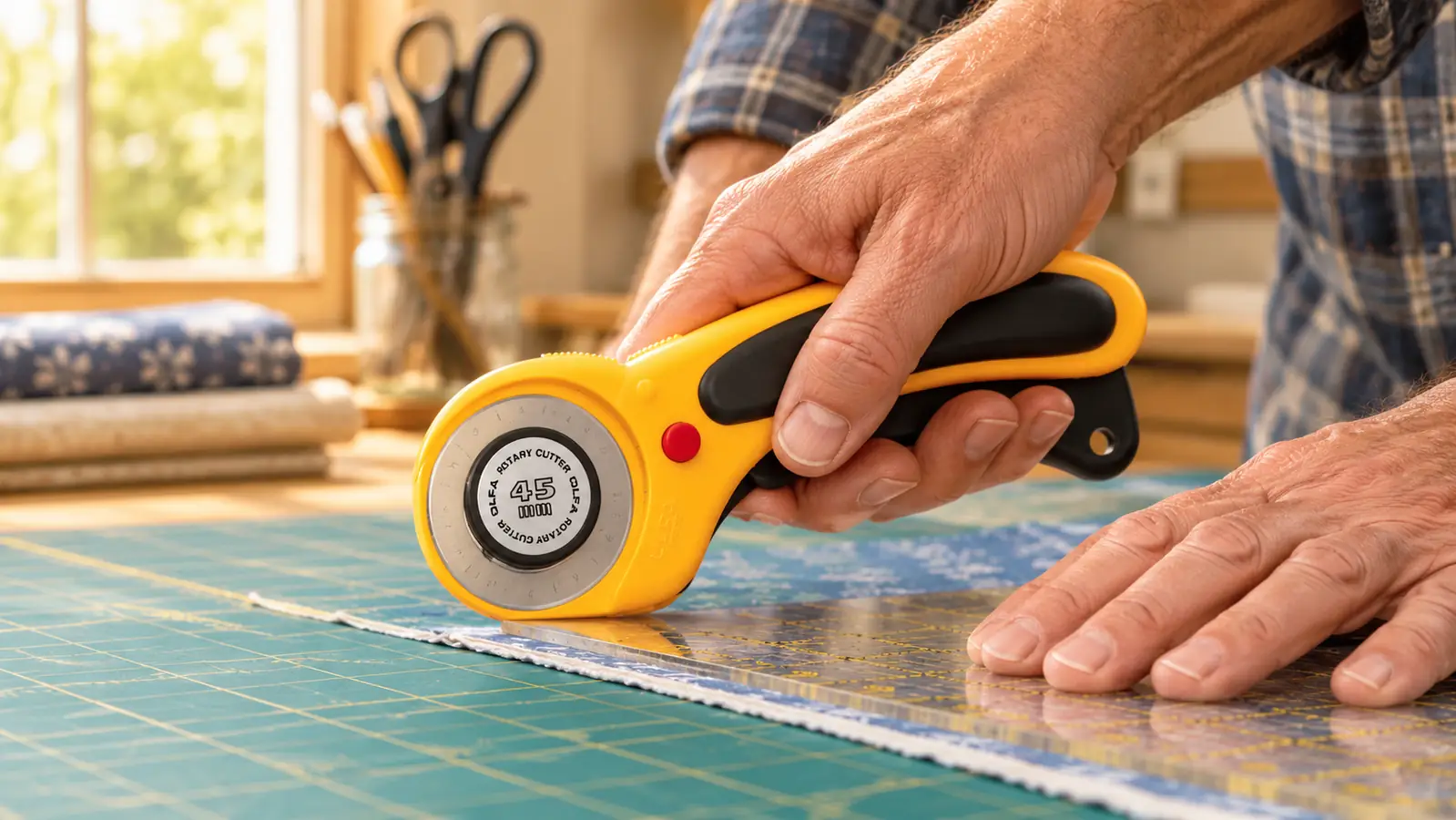
The handle is a squeeze trigger, not a thumb button, and that distinction matters to me more than any other design choice on the tool. A thumb button puts all the work into the joint that already hurts. With a squeeze handle the pressure spreads across the fingers and the palm and my thumb mostly comes along for the ride. On a long cutting session that is the difference between stopping at four in the afternoon and stopping because I am finished.
The handle is rubber, and the whole cutter weighs two point four ounces, which is light enough that I simply do not notice holding it. Light does not mean flimsy. I have dropped this thing on a hardwood floor twice, once from a decent height, and it came through with nothing worse than a scuff. The lightness does work against you in one specific situation, and I will be honest about that further down.
The grip did take learning. I have small hands and I had to find where to seat the heel of my palm so the squeeze felt natural instead of cramped. That was maybe two cutting sessions. Now I do it without thinking about it. But if you have very large hands, hold one before you commit, because a squeeze handle is a hand-fit tool the same way a pair of shears is.
The Auto-Retract Is the Reason to Buy This Version
The blade is out only while you are squeezing. Let go and it pulls itself back inside the handle. I did not expect to care about that. I have been around sharp things my entire working life and I am careful. Then I set the cutter down on the mat mid-cut to shift a ruler, and the blade disappeared on its own while my hand was nowhere near the trigger. Nothing happened. That is exactly the point. Nothing happened because the tool was built so that nothing could.
This matters more than the listing copy makes it sound, because the way you really cut with a rotary cutter is stop, start, stop, start. You cut one strip, you move the ruler, you cut again. Every one of those pauses is a moment when an open blade is sitting on a table in a house with a cat in it. Pockets is nine and she naps on whatever fabric I have laid out, so an unattended blade is not a theory for me. If I could keep only one feature, this would be the one.
Here is a scene from a Thursday in March that sums it up. I was cutting binding strips, ten of them, four layers each, and the telephone rang. I do not move fast anymore, but I moved fast enough to set that cutter down and answer it. It sat there on the mat for eleven minutes with the blade inside the handle while I talked to my daughter about a bridal shower. When I came back I picked it up and squeezed and the blade was there exactly as it should be. With a thumb-slide cutter, and I have owned two, that is eleven minutes of an open razor on a table with a cat on the premises. You do not buy that safety, and then you do.
What Nobody Tells You About Rotary Cutting
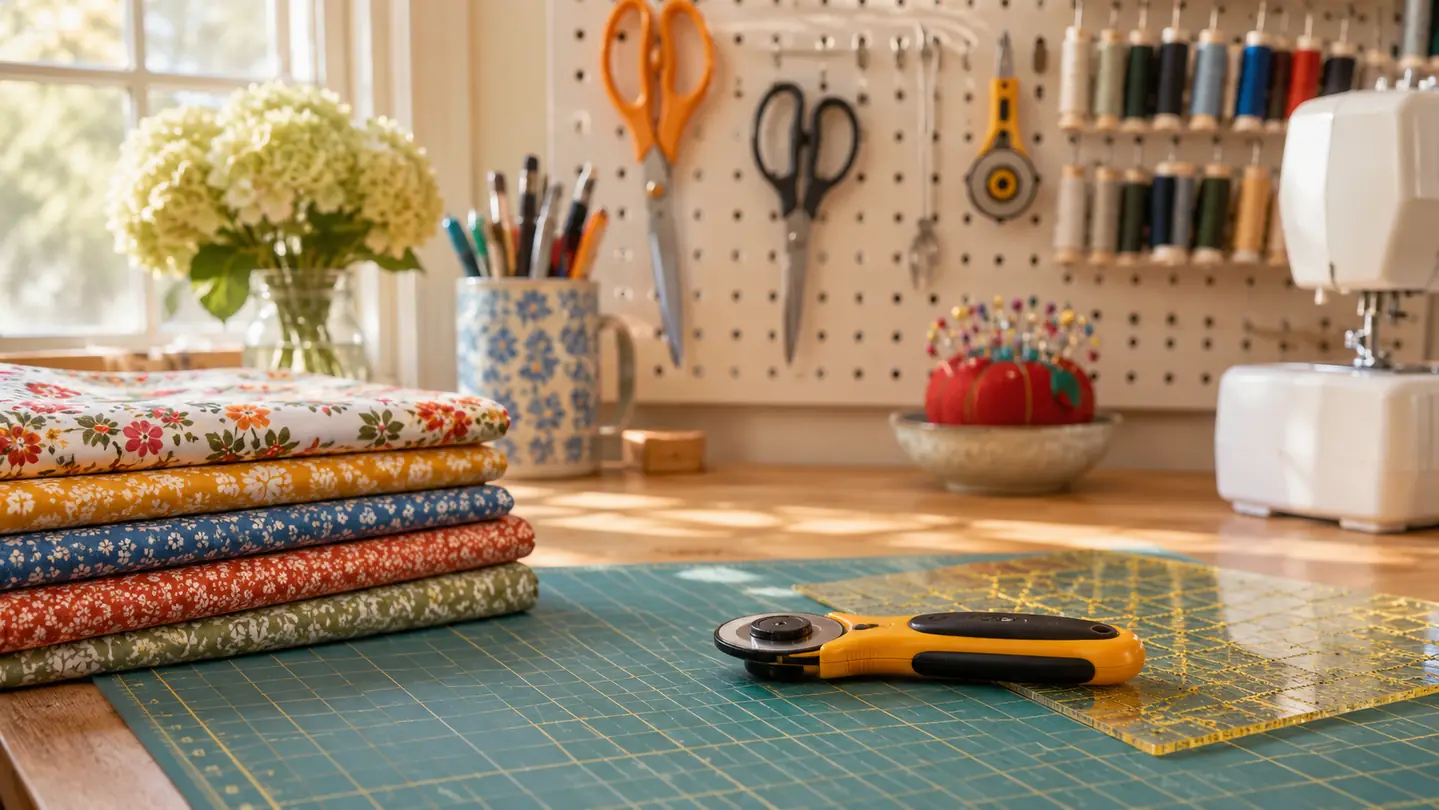
Nobody tells you that the cutter is not the whole purchase. You need a self-healing mat underneath it and a clear ruler on top of it, or you will be cutting freehand, and freehand rotary cutting is how people decide they hate rotary cutters. The blade needs a surface that gives slightly. Your fabric needs a straight edge to run against. The OLFA is a fine tool and it cannot do this job alone. Plan for the mat and the ruler in the same breath as the cutter, or you will be disappointed for reasons that have nothing to do with the cutter.
Nobody tells you that pressure is the wrong instinct. Mine came from shears, and my instinct was to bear down hard. A rotary blade does not want that. You want a firm, even push forward and just enough downward contact to keep the blade in the fabric. Press too hard and the blade climbs, the ruler slips, and your strip goes from two and a half inches to two and three eighths by the end of it. I ruined three strips before I believed this. Ease up and the line stays true.
The mat matters more than the price tag on the mat suggests. My first mat was a cheap one, eighteen by twenty-four inches, and I outgrew it in a month. Cutting a forty-two inch length of backing fabric on an eighteen inch mat means sliding fabric and resetting the ruler halfway through, and every reset is a chance to be off by a quarter inch. I now cut on a mat closer to twenty-four by thirty-six, and one pass covers what used to take three. If you are a quilter, buy the bigger mat the first time. It is the purchase I regret making twice.
And nobody tells you to cut away from your body and off to the side, not straight back toward your chest. It sounds obvious written down. It was not obvious to me the first time I picked one up, and I have a small scar on my left index finger to prove it. That scar came from a mat slip, not from the auto-retract, and I think it is fair to note both of those things.
Blade Changes and the Blades That Fit
I changed the blade once, mostly to see how the system worked, and then I put the original back because it was still cutting cleanly. The change took under a minute with no tools and no swearing. OLFA built the swap so the blade comes out without your fingers going anywhere near the edge, which is more than I can say for the seam ripper I have owned since 1998. If you have ever fought a utility knife over a stuck blade, this will feel civilized.
The same handle also takes the OLFA pinking blade, the scallop and peak blade, and the wave blade, so one body covers decorative edges as well as straight ones. I have only used the straight blade myself and I will not pretend to review the others. What I can tell you is that the swap is easy enough that I would not dread changing over for a single project, which is not something I can say about most tools with interchangeable parts.
One practical note. A rotary blade does not sharpen. When it starts skipping threads instead of slicing them, it is finished, and you replace it rather than fight it. The blade that came loaded in this handle has lasted eight months of regular cutting on quilting cotton, and it will go faster if you cut a lot of flannel or anything with sizing in it. Buy a spare before you need one, because the day you need it you are mid-project and you will not want to stop and shop.
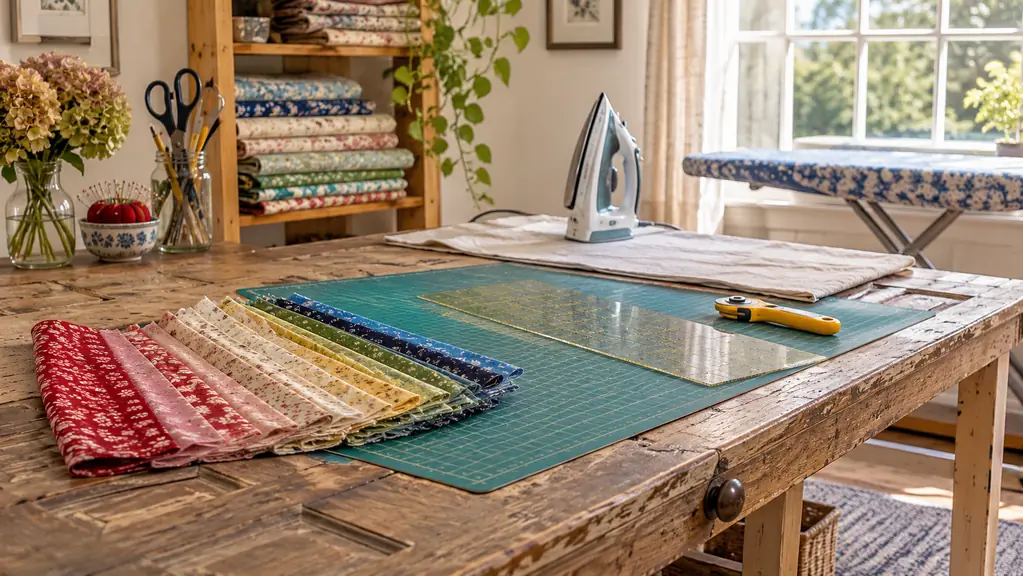
Pressing is the other half of it, and this is where an honest review has to leave the tool for a minute. Cut pieces are not finished pieces. I press every seam as I go, and I press the fabric before I cut it, because a crease through four layers will throw a strip off by a fat eighth every time. My ironing board sits by the window in that spare room and I probably walk between the board and the cutting table forty times on a quilt. It is slower that way. The quilts come out square that way. If you are looking for a tool that removes the pressing, this is not it and nothing is.
What I Liked
- Squeeze handle spreads the work across the hand, which suits an arthritic thumb
- Blade self-retracts the instant you let go, so a cutter set down mid-cut is never an open blade
- Cuts four layers of quilting cotton in one pass
- Blade changes take under a minute, with no tools and no fingers near the edge
- Two point four ounces, so the hand does not tire from the weight of the tool
- Takes the OLFA pinking, scallop and wave blades as well
- Manufacturer lists the guarantee as forever
Where It Falls Short
- Needs a mat and a ruler to be worth anything, and neither is in the box
- The light body can wander on thick stacks if you push too fast
- The squeeze trigger takes a couple of sessions to fit a small hand comfortably
- Unforgiving for a beginner who will not practice on scrap first
- A slip will gouge a mat and nick a ruler permanently
Let go of the handle and the blade is already back inside. That half second is the reason this cutter lives on my table instead of in a drawer.
The Tradeoffs I Live With
The light body has a downside. On a thick stack, four layers of denim or a folded quilt binding, this cutter wants a steadier hand than a heavier one would. It will wander if you rush it. I cut binding for a lap quilt and had to slow down and take it in two passes instead of one. A heavier cutter might have muscled through. I would still choose the light one, because the effort I save on every ordinary cut matters more to me than the one cut in ten where I have to slow down.
The other thing I live with is that this is a tool that wants a little respect. It is not a pair of scissors you can hand a visiting grandchild without a thought. Anyone using it needs to understand that the blade is out while the handle is squeezed and only then. That is a five-second conversation, but it is a conversation you have to have, and if you are not going to have it, put the cutter up high.
Who This Is For
This is for the person who cuts fabric more than once a month and whose hand complains about it. If you have arthritis, or a weak grip, or you are simply tired of lifting and repositioning shears on every square, the squeeze handle is the feature that earns its keep. It is also for the quilter cutting multiples of the same shape, where four layers at a time turns an evening of work into an afternoon. And it is for anyone who has ever set a rotary cutter down with the blade out and felt that small cold feeling in the stomach. This version removes that feeling.
Who Should Skip It
Skip it if you sew once a season and mostly hem one pair of trousers, because a mat, a ruler and a cutter is a lot of kit for that job and your shears will do fine. Skip it if you will not spend twenty minutes practicing on scrap, because a rotary cutter is unforgiving about technique and you will blame the tool for it. Skip it if you want to cut curves. This is a straight-line tool and it is honest about that. And skip it if you have no intention of buying the mat and the ruler, because without them the OLFA will underperform and you will believe the money went on the wrong thing.
The blade goes back inside before you can forget about it.
Loaded with an RB45-1H Endurance blade, covered by a guarantee the manufacturer describes as forever, and light enough that your hand forgets you are holding it. Bring a mat and a ruler and it will do the rest.
Amazon Check Today's Price on Amazon →