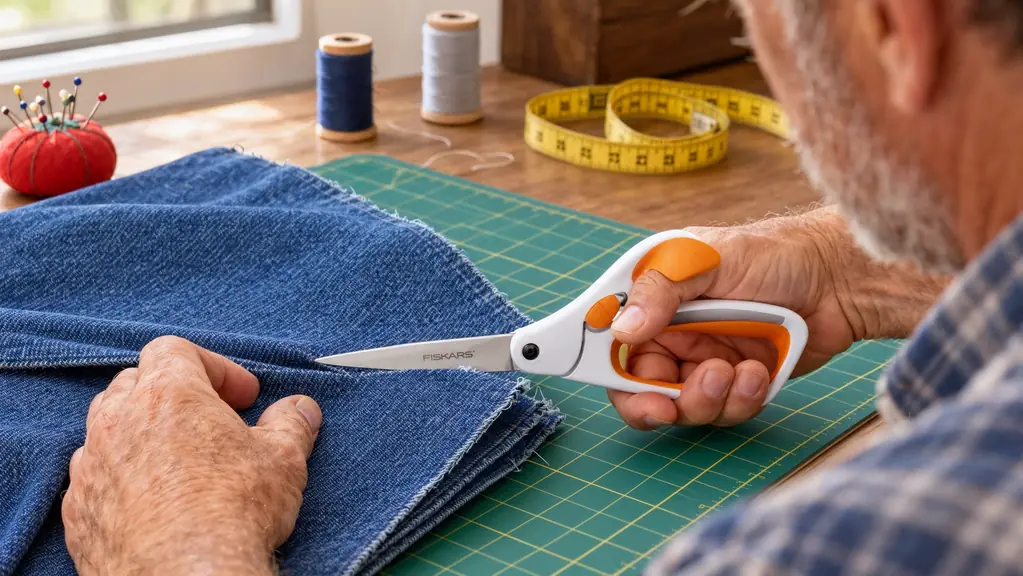
The first thing I noticed about the Fiskars No. 8 Easy Action scissors was not the cut. It was my thumb. I was hemming four pairs of jeans for a neighbor, the kind of job where you cut through doubled denim and then keep cutting for an hour, and somewhere around the third pair I noticed my right thumb had stopped complaining. I am 74 years old. I ran an alterations counter in a dry cleaner for 22 years, and my thumb has opinions about every tool that comes into this room. It does not often change its mind. That was the day I ordered a second pair of Fiskars and hung it on the pegboard by the window, which is the highest compliment I give a tool.
Here is the part of the story the listing does not lead with. The spring does not do the cutting. It does the letting go. An ordinary pair of shears makes you open the blades with the very same muscles that closed them, and after a few hundred cuts it is the opening that wears you down, not the squeezing. These scissors push themselves back apart after every cut, so you only ever work in one direction. That sounds like a small favor. In a room where I still take in mending for the neighbors, it is the difference between finishing the hemming on Tuesday and leaving it on the cutting table until Friday.
The Quick Verdict
A genuinely easier pair of scissors for long straight cutting jobs and tired hands. The spring is the reason to buy it, and for the first week it is also the reason you will get annoyed.
Amazon Check Today's Price →Finish the whole hem without stopping to shake out your hand
The Fiskars No. 8 Easy Action bent scissors carry a limited lifetime warranty and close to 7,000 ratings from other people who cut for a living or close to it.
Amazon Check today's price on Amazon →How I've Used Them in This Room
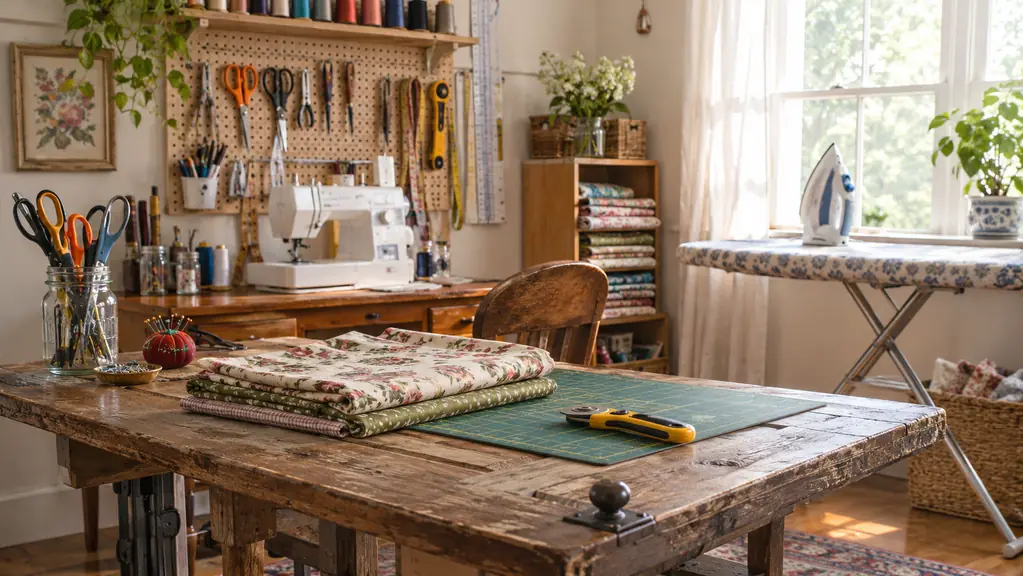
I keep the Fiskars No. 8 on the pegboard to the right of the ironing board, which is where my hand goes without thinking. Since March I have used them on heavyweight denim for hem repairs, on quilt binding, on a stack of cotton batting, and on the silk lining of a dress I was taking in for myself. The denim is the real test. Two folded layers of it will make an ordinary pair of household scissors slide and chew, and these went through without me having to saw. The blade is listed at 8 inches on a 10 inch pair, with a straight edge and a round point, and that length is what gives you the leverage on a thick seam.
The heaviest thing I have put them through was a pair of work jeans in June with a double-stitched hem that had already been let down twice. That is four layers of denim at the side seam if you count the fold. I chalked the new length at 29 inches and cut from the outside seam inward in one pass. The blades did not slide, and the edge came out within an eighth of an inch from end to end.
The batting was where they surprised me. Batting is not hard to cut, it is just bulky, and a long blade handles bulk better than a short one because you are making fewer passes. I squared up a crib quilt in about the time it used to take me to wrestle the roll open on the table. Where they are less happy is a tight curve. Setting in a sleeve, clipping a curve on a neckline, any of that fine work, and the length starts working against you. I keep a small pair of snips within reach for those moments and I would not want to be without them.
One job I did not expect to like them for was mending. I took in a coat with a torn lining and a split seam at the pocket, and instead of dragging out the machine I cut a patch and trimmed the frayed edges by hand. The bent handle keeps your wrist up off the table, so I could see what I was doing without leaning over, and the long blade let me cut a straight edge on a patch that was already half attached. That is not the job these were sold for. It is the job I keep reaching for them to do.
The Spring Is the Whole Story
Fiskars calls the handle Easy Action, and the mechanism is a spring assist in the grip that gently opens the blades after each cut. There is also an easy-open thumb lock, which is the small lever you push to hold the blades shut for storage. Those two details are the whole product. Everything else about the scissors, the stainless blades, the titanium coating, the bent handle angle, you can find on a dozen pairs on the shelf at a fabric store. The spring assist is the reason a person with a tired thumb or a cranky wrist picks these up instead of the pair next to them.
I timed it, because I am that sort of person. A 30 inch curtain hem, one layer of cotton, cut with my old flat-handled shears: just over four minutes, and I stopped twice to open my hand. The same hem with the Fiskars: two minutes forty, no stops. That is not a scientific test. It is one Tuesday morning in a spare bedroom, and it is why the second pair went on the pegboard.
It takes a week to stop fighting it. I am serious about that. For the first few days the blades kept springing apart when I wanted them closed, and if you are someone who likes to hold the scissors shut and slide the closed blades along a seam line to true it up, the spring will not let you do that the way you are used to. You adapt. I now true a seam by cutting with the tips instead, or by pressing it first and cutting to the crease. A newer sewist might find the adjustment more annoying than I did, because I have fifty years of habits to unlearn and half of them were not that good to begin with.
The spring does not make the cut easier. It makes the release easier, and the release was the part that hurt.
Why the Bent Handle Matters More Than You Think
People talk about bent scissors as though the angle were a comfort feature. It is really about the table. When the handle is bent, the blades ride flat along your cutting mat and the wrist stays level instead of cocked up in the air. On a long straight cut down the fold of a bedsheet, that is the difference between a line that runs true and a line that wanders because your hand is slowly tipping. I cut a set of curtains in April and the bottom edge came out square on the first try, which is not something I could say for the flat-handled shears I used for years.
The catch is that flat-on-the-table cutting is exactly what makes them awkward when you lift the work up. When I take a garment off the table and into my lap, which I do constantly, the bent handle is now the wrong shape for the job and the length is in my way. So the answer to whether the bend is worth it depends entirely on whether you cut on a table or in the air. Table cutters will wonder how they lived without it. Lap cutters will wonder why anyone bothers.
What the Titanium Coating Does and Does Not Do
The blades are high-grade, precision-ground stainless steel with a titanium coating, and Fiskars says the edge cuts to the tip. In practice that means two things. The coating reduces friction, so the blade slides through fabric rather than dragging at it, which matters most on anything with a nap or a loose weave. And the cut does carry all the way to the point, so you can start a cut in the middle of a piece without sawing at it. What the coating does not do is keep the blades sharp forever. Nothing does. Titanium coating is not a sharpening substitute and any listing that implies otherwise is selling you a feeling.
My care routine is unglamorous. I wipe the blades with a dry cloth after anything fuzzy, because lint and thread dust work their way into the pivot and make the action stiff. I keep a small drop of sewing machine oil on the pivot about once a month. I do not cut paper with them, ever, and I do not leave them open on the table where the cat can walk across them. Fiskars backs them with a limited lifetime warranty, and I have never had to test that on any pair I own, which is either a good sign or a sign that I baby my tools. Probably both.
Where the Fiskars No. 8 Falls Short
The honest answer is that these are a specific tool for a specific job, and they are not the pair you reach for all day. At 4.8 ounces they are not heavy, but they are long. On a 10 inch pair with an 8 inch blade, the length that gives you leverage on denim also makes them clumsy for armholes, small curves, and anything you would normally do with the tip. The round point is safe and it is sensible for a shared workroom, but it will not let you pierce fabric to start a cut from inside a seam. I keep a pointed pair for that.
The job that made me put them down was a run of sixteen cushion covers in September, each with a boxing strip around the edge. Every strip corner needs a clip of about a quarter inch so it will turn. I tried the first two with the Fiskars and made a mess of both, because the tips sit too far from my fingers and the round point kept riding up over the corner instead of biting in. The other fourteen I did with the small pointed snips in under an hour.
The thumb lock is the one thing that genuinely irritates me. It is small and it takes a firm push to click open, which is a strange design choice on a pair of scissors sold to people whose hands are tired. My thumb manages it. My neighbor, who has worse hands than mine, handed them back to me twice before she got it open. The other tradeoff is the one I mentioned earlier and it is worth repeating, because it is the thing that decides whether you love these: the spring works against you any time you want the blades to stay partly closed. If your cutting style depends on that, these will feel wrong no matter how good the steel is.
What I Liked
- The spring assist opens the blades for you, which is the part that tires a hand out on long cutting jobs
- 8 inch blades on a 10 inch pair give real leverage on doubled denim and thick seams
- Bent handle keeps the blades flat on the mat and the wrist level, so long straight cuts run true
- Precision-ground stainless blades with a titanium coating slide through fabric instead of dragging
- Listed as ambidextrous, and a left-handed neighbor cut through quilting with them without complaint
- Limited lifetime warranty, and at 4.8 ounces they are light enough to hang on a pegboard all day
Where It Falls Short
- The spring fights you whenever you want to hold the blades partly closed, which some habits depend on
- 10 inch length is too much for armholes, tight curves, and tip work
- Round point cannot pierce fabric to start a cut from inside a seam
- The thumb lock is small and takes a firm push, which is a poor fit for the hands this tool is aimed at
- No sheath or cover included, so a drawer storage person will need to sort something out
The Small Things the Listing Will Not Tell You
The hand orientation is listed as ambidextrous, and I checked that with a left-handed neighbor who cut right through her quilting with them, so the claim holds up. The blade edge is straight rather than serrated, which is the right choice for fabric and the wrong choice for anything slippery that you would normally grip with a serrated edge. The included components are just the scissors, so there is no sheath and no cover, and if you keep your tools in a drawer rather than on a pegboard you will want to make one or buy one. I have a pegboard, so mine hangs and that is the end of it.
One more thing no listing can tell you. These feel solid in a way that cheap scissors do not. There is no rattle at the pivot and no flex in the handle when you bear down on a thick seam. I have owned scissors where the two halves started to separate after a year of hard use, and I do not expect that here. Whether that holds for ten years I cannot tell you, because I have had this pair for less than one. I can tell you the Fiskars name has been on my pegboard since the 1980s and I have never thrown one of them out.
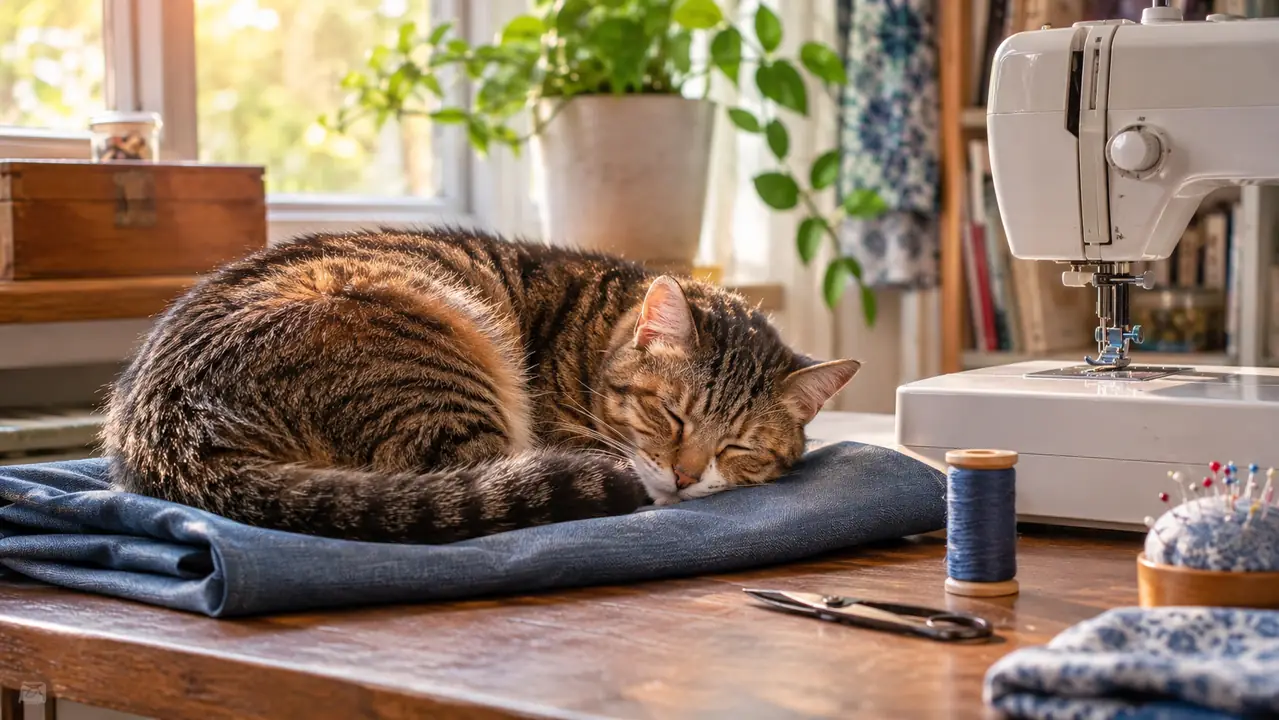
I will also tell you the ungrateful part. Pockets, my gray tabby, has decided the folded fabric on the cutting table is a bed, which means I now wipe the blades down every single time before I start, because cat hair in a pivot is the fastest way to ruin a good pair of scissors. That has nothing to do with Fiskars and everything to do with living with a cat. But it is real shop floor life, and if you have one too, get in the habit of a wipe before you cut.
Who This Is For
This is for the person who cuts for an hour at a stretch and pays for it afterward. Quilters cutting binding and backing, home sewists doing a run of mending, anyone with arthritis or a thumb that has started to complain, anyone who has noticed that the squeezing is fine but the opening is what makes them put the scissors down. It is also a sensible pair for a shared sewing room, because the round point means nobody is going to stab themselves reaching for it in a basket. If you are the one in your family who hems everybody else's trousers, this is a reasonable tool to keep by the machine.
Who Should Skip It
Skip it if your cutting is mostly small, curved, and close to the needle. Skip it if you do applique, or doll clothes, or anything where the tip does the work. Skip it if you are devoted to sliding your closed blades along a line, because the spring will fight you every time. And skip it if you want one pair of scissors to do everything in the house, because these are not that pair. They are a long, bent, spring-assisted cutter for straight runs and thick seams, and a small sharp pair of snips is still the tool that lives next to my machine.
If your thumb is the thing that ends a cutting session, start here
Ten inches, 8 inch blades, spring assist, limited lifetime warranty. Not the pair for every job in the room, but the one I reach for when the pile of mending is taller than my patience.
Amazon Check today's price on Amazon →