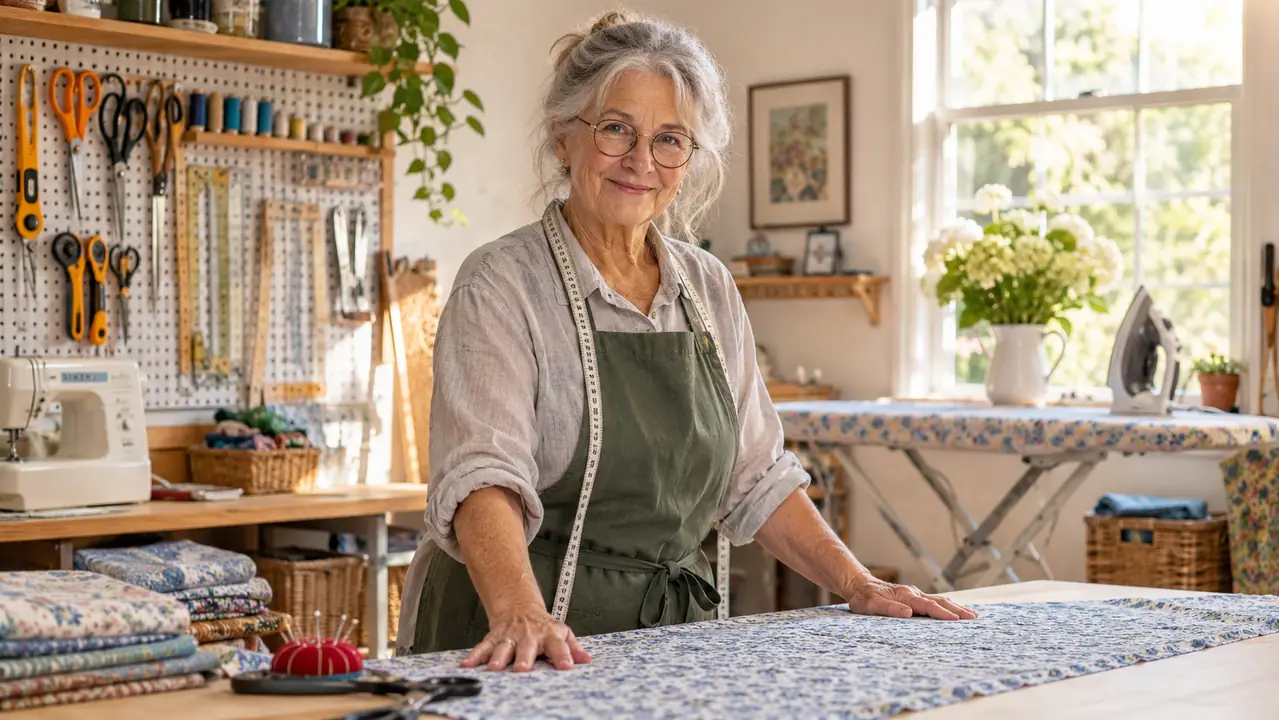
My right thumb started arguing with me about six years ago. I did what most of us do. I kept using the same shears I had owned since the nineties and told myself the ache was part of the job, the same way a sore back is part of standing at an alterations counter for twenty-two years.
It was not part of the job. It was arthritis, and it turned a ten minute hem into a forty minute negotiation. The thing that changed my cutting table was not a new technique or a tougher grip. It was a pair of Fiskars Easy Action scissors with a spring in the handle, and I have thought about that handle more than any other tool in my sewing room. Here are ten reasons, in the order they actually mattered to me.
The hinge does the half of the work your thumb used to do
Fiskars No.8 Premier Easy Action Bent Scissors, 10 inches, with a spring-assisted handle that opens itself after every cut. Read what people with sore hands say about them.
Amazon Check availability on Amazon →The handle opens itself after every cut
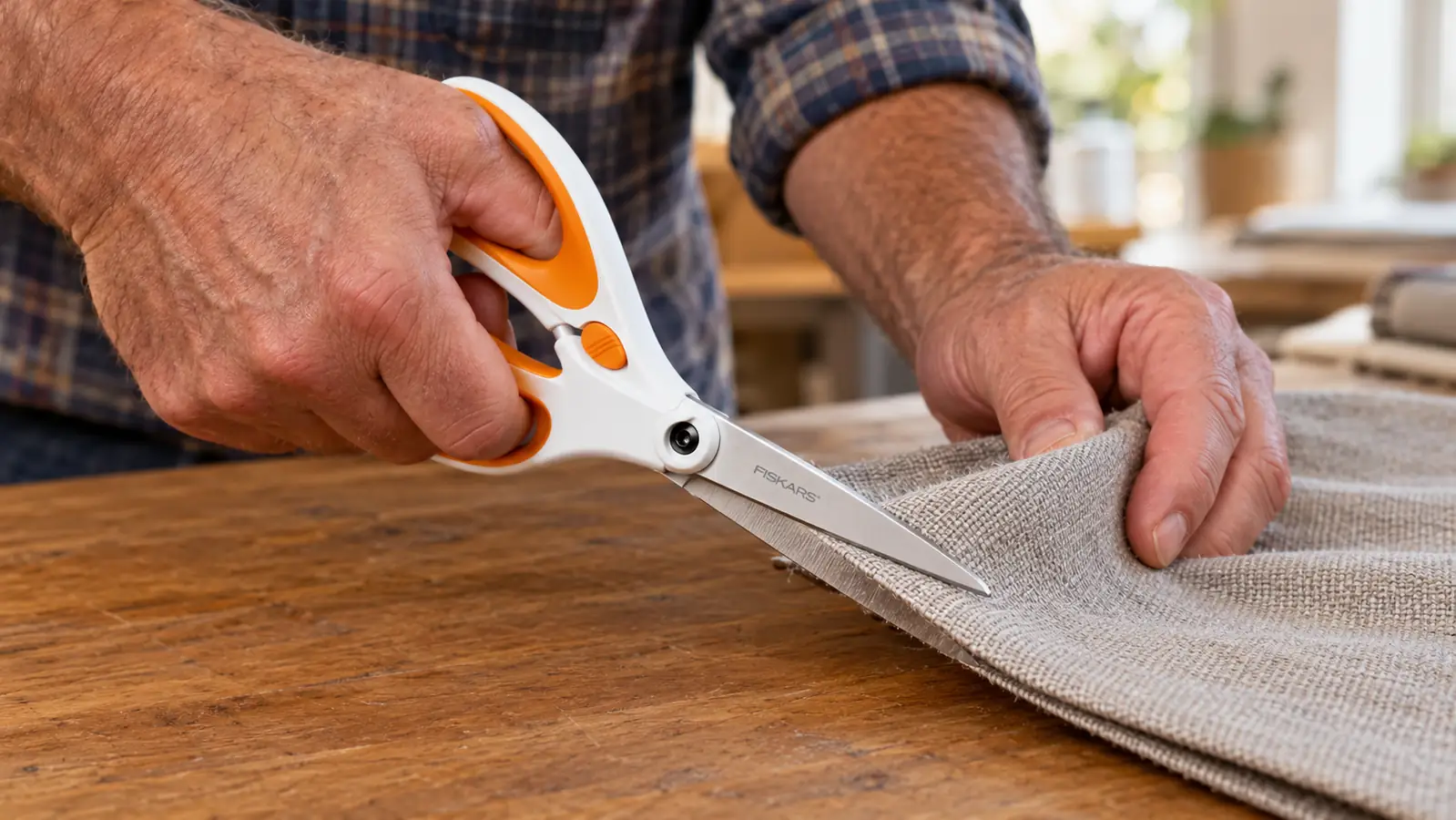
This is the whole idea and everything else is detail. On ordinary scissors you squeeze to close and then pull your fingers apart to open, again and again, hundreds of times on a long seam. The spring-assisted handle on the Fiskars pair gently opens the blades for you after each cut. When I first used them I kept catching myself holding my breath waiting to do the opening part, and then realising I did not have to.
Your thumb only has to close, never open
Arthritis in the thumb is worst on the release, not the squeeze. Closing a blade is a whole hand movement and you have the meat of your palm behind it. Opening is that small, mean little motion in the base of the thumb, over and over. Take away half the motions and you take away the half that hurts. I could feel the difference by the second seam, which is faster than I expected and the reason I stopped looking at other options.
It cuts clean to the tip, so you stop repositioning
Every time you have to lift the fabric, set it down again and take a fresh bite, that is another squeeze for your thumb. The precision-ground blades on this pair cut right to the tip. On collars and armholes and any place where I used to shuffle the fabric along, I now just keep going. Fewer repositionings on a garment means fewer squeezes, and I would rather have a better blade than a stronger hand.
The titanium-coated blades go through denim and layers
My work was hemming, and hemming means denim, and denim means a doubled seam with a fold inside it. Dull scissors make you squeeze harder, and squeezing harder on a hard material is exactly how a thumb gets angry. These blades go through multiple layers without me leaning into them. Stainless steel with a titanium coating, and mine have held their edge through a good deal of blue jeans.
The thumb lock opens without a fight
A stubborn lock is a small thing until you have sore hands, and then it is the reason you leave the scissors open in a drawer and dull them. The easy-open thumb lock on this pair is a light push and it is done. I can open and close it one-handed while I am holding fabric in the other hand, which sounds like nothing and is actually the difference between using the lock properly and not using it at all.
It works in either hand
My right thumb is the bad one, so there are afternoons when I cut left-handed and make a poor job of it. These are ambidextrous, so the pair I bought for my right hand is also the pair I use on my bad days. If you have arthritis that moves around, or if you sew with someone who is left-handed, you do not have to buy twice. That matters more than the catalogue makes it sound.
Light enough to hold through a long session
At just under five ounces, they are not a strain to lift. This is a quieter reason than the spring, but the weight of a tool adds up over two hours of quilt binding the way a heavy shopping bag adds up on the walk home. Heavier shears cut well and tire you out. I keep this pair out on the table and reach for it without thinking, which is the honest test of any tool.
The bent handle keeps your fabric flat on the table
The bend in the handle lifts your knuckles clear so the bottom blade rides along the table instead of dragging the fabric up with it. Cutting flat is faster and more accurate, and it also means your wrist is not cocked at an awkward angle for the whole length of a seam. If your hands complain, your wrists are usually complaining too, and this shape is kinder to both. The round point is also easier to keep away from a finger.
Ten inches of length gives you leverage
Ten inch scissors with an eight inch blade give you a longer lever, and a longer lever means the material does the resisting instead of your hand. On a straight cut down a curtain panel I am using my arm and the length of the blade, not my thumb. I keep a small pair for snipping threads and this long pair for anything that needs a real cut, and the long pair is the one that saved my hands.
A limited lifetime warranty behind them
I have thrown out more pairs of cheap scissors than I care to count, and every one of them was a false economy. These come with a limited lifetime warranty, which tells you what the maker expects of them. Mine have been in near daily use and the spring still has its snap. For a tool you will hold every week for years, buying the one with a warranty behind it is the cheaper road in the end.
What I'd Skip
I would skip the little spring-loaded snips sold at the craft store counter. They are fine for threads and hopeless on a folded hem, and you end up squeezing twice as often on a smaller blade. I would skip the padded grip covers too, at least at first. They bulk up the handle and change where your fingers sit, and the spring is doing the real work anyway. Start with the plain pair and give your hand two weeks to decide. And I would skip buying three sizes at once. One good ten inch pair on the table will tell you more than a drawer full of options.
Forty minutes of hemming became twelve, and my thumb had stopped throbbing by the second seam.
Start with one pair, not five
One ten inch Fiskars Easy Action pair on the cutting table will tell you in a fortnight whether your thumb agrees with me. That is the whole test.
Amazon Check availability on Amazon →