Twenty-two years behind an alterations counter taught me to judge a pair of scissors by the end of the day, not by the first cut. A sharp blade is easy to find. A pair your hand still wants to pick up after four hours of hems is the one that earns a hook on the pegboard.
My right thumb has mild arthritis. It complains about rotary cutters, about pinking shears, about anything that asks me to squeeze and squeeze again. So when the Fiskars No. 8 Premier Easy Action bent scissors landed in my sewing room here in Lakeland, I did what I do with every tool that arrives: I put it to work on a neighbor's pile of jeans and let a few months decide. This is where that landed.
The Quick Verdict
The spring opens the handle so my thumb does not have to, and the blades still cut clean to the tip six months on. The thumb lock took me a week to stop triggering by accident. That is the entire complaint.
Amazon Check Today's Price →The pair my thumb stops arguing with
A spring-assisted handle that reopens itself after every cut, titanium-coated blades that stay sharp to the tip, and a lock that keeps them shut in the drawer. Check today's price on Amazon.
Amazon Check Today's Price on Amazon →How I've Used It
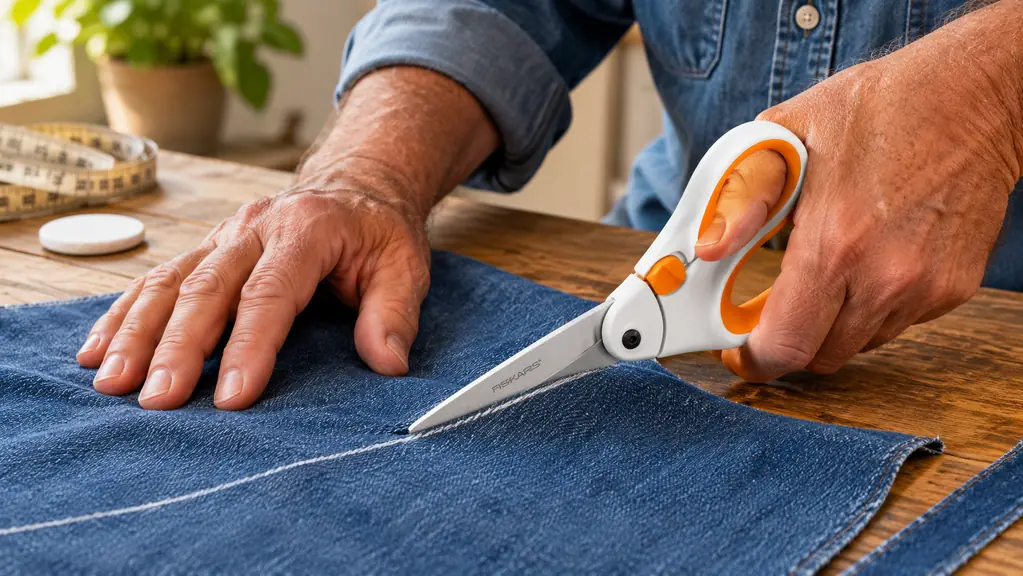
The first job was a stack of six pairs of jeans for a neighbor whose grandson grows like a weed. Hem, hem, hem, one after another, with a flat-felled seam on two of them that meant cutting through four layers of denim at the outside leg. That is the test that separates a household pair from a sewing pair. The Fiskars went through the seam without rocking and without chewing, and the round point meant I was not stabbing myself every time I shifted my grip on the fabric.
The measuring matters, so here it is. A pair of jeans hemmed to a 5/8 inch turn, twice folded, means three passes of the blade per leg and four legs per pair, so twenty four cuts before I even reached the flat-felled seams. I did the first pair with my old straight-handled shears, the ones I have had since the counter days, and by the second leg my thumb was doing that thing where it simply does not want to reopen. That is when I switched. The Fiskars finished the remaining ten legs and the two seams, and I did not have to shake my hand out once.
After that came the quieter work. Binding on a crib quilt for my granddaughter, which is hours of small repeated squeezes that a stiff pair turns into a dull ache by mid afternoon. Then a silk dress lining, which is the opposite problem entirely: thin, slippery fabric that wants to slide away from the blade instead of being cut by it. The spring on these returns the handle to open on its own, so my fingers only ever close, never pull apart. That sounds like a small thing. After two hours it stops being small.
I have also, I admit, used them on paper. Grocery lists, pattern paper, the cardboard back of a notebook. They are built to cut paper and denim and silk and multiple layers, and they have not seemed to mind the variety. I keep a separate pair for fabric because that is the habit of fifty years, but a tool that can do both without complaint is a tool that gets picked up more often, and that counts for something.
What the Easy Action Spring Actually Does
The handle is spring assisted. That is the whole idea, and it is the reason these live on my pegboard instead of in a drawer. Between cuts the spring pushes the handle back open, so your hand performs one motion instead of two. For anyone whose thumb is stiff in the morning, or who is cutting out a pattern with forty small snips around a curve, that halves the work.
Everything else is sensible and unglamorous. High grade stainless steel blades, precision ground, with a titanium coating that helps them stay sharp and helps fabric slide through instead of dragging. Fiskars grinds the edge so it cuts clean to the tip, which matters more than people expect, because the tip is where you clip into corners and trim a seam allowance without cutting the stitches you meant to keep.
The pair weighs 4.8 ounces, light enough that my wrist does not notice it by the end of an afternoon. The point is round, so if you sew with the radio on and your mind somewhere else, you are less likely to open a finger. Hand orientation is ambidextrous, which matters in a house where a left handed grandchild occasionally sits down at my machine. And there is an easy open thumb lock that keeps the blades shut when the scissors are not in use.
Cutting Real Things: Denim, Silk, and Four Layers at Once
Here is what I actually cut with them over these months, in the order I remember it. Denim, from 10 ounce work jeans up to a heavy pair of carpenter pants that had already been patched twice. Quilter's cotton, cut on the fold, two and three layers at a time, which is where a dull pair shows itself as a stepped edge instead of a clean line. Silk lining, slippery and mean. Batting, which is like cutting a cloud and always leaves lint in the pivot. Paper patterns. A length of curtain cord that I probably should have cut with something else.
One Saturday in March stands out. A neighbor brought over a quilt top her mother had started and never finished, and asked me to square it up and bind it. Squaring a quilt means cutting through the top, the batting and the backing together, and those edges had been fraying in a cedar chest for forty years. I used a long ruler and a rotary cutter for the straight runs across the middle, because that is the right tool for that job. Then the Fiskars did everything the rotary cutter could not reach: the four corners, the places where a seam allowance had bunched up, and the last inch at the end of every pass where the ruler ran out. That is the pattern of how I use them now. Rotary for the long lines, these for the short work and the corners.
The one place I noticed a real difference from a heavier pair of shears was at the tip. Long cuts across a wide table are easy for almost any sharp scissors. It is the last half inch of a clip, at a notch or a corner, where a blade that is not sharp to the tip starts to push the fabric instead of slicing it. These slice. I have not had to re-cut a corner once.
The spring, though, is the part to pay attention to if you are buying for a reason. If your hands are fine, it is a pleasant convenience and nothing more. If your hands are not fine, it is the difference between finishing the quilt binding tonight and leaving it on the table until tomorrow. That is not a small margin when you are 74 and the binding has been on the table since Tuesday.
Four layers of denim at a flat-felled seam, no rocking, no chewing, and my thumb was not sore afterward. That is the whole review in one sentence.
The Thumb Lock and Other Small Frictions
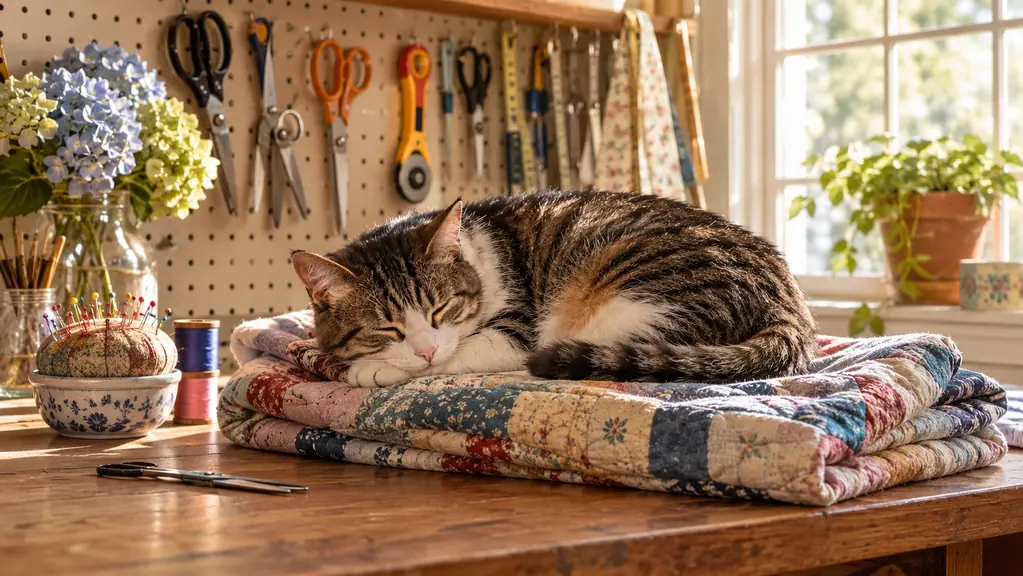
I do not love the thumb lock. It works, it opens easily enough with one thumb, and it does keep the blades closed in a drawer where a cat is known to go rummaging through whatever fabric I left out. But it sits right where my thumb wants to rest, and for the first week I kept triggering it by accident in the middle of a cut. By the second week my hand had learned to sit a quarter inch further back and it stopped being an issue. I mention it because nobody warns you, and the first week is annoying.
The spring is also the maintenance. Lint, thread snippets, and the fine dust from cutting batting all collect around the pivot and inside the handle where the spring sits. A pair of plain shears you can blow clean. These want a few seconds with a small brush every couple of weeks and a drop of oil at the pivot now and then. If you never do it, the action starts to feel gritty. Mine got there once, and a two minute clean brought them right back.
I keep a small brush in the drawer for exactly this. The lint that comes off batting is the worst of it, fine and pale, and it works its way into the gap between the blades, so after a long session of quilt work I can feel it in the action before I can see it. Two minutes with the brush, a drop of oil on the pivot, a few open and closes to work it in, and they are back. I do it on the first of the month now, same as I change the needle on the machine, so that I do not have to think about it.
And they are not a fine instrument. The blades are ground to handle a range of materials, which means they do a beautiful job on denim and a merely good job on delicate silk. If you are sewing a wedding dress, you want a dedicated pair of dressmaking shears with a longer blade and a keener edge. These are the pair you keep out and use, not the pair you keep in the box.
Months Later: How They Have Held Up
Six months in, the blades still cut clean to the tip. I have not sharpened them and I do not plan to for a while yet. The titanium coating on the blade face still lets fabric slide rather than drag, which is the thing that keeps a cut line straight when you are working quickly. The pivot has stayed tight with no wobble, which is the failure I have seen on cheap spring loaded scissors, where the two halves start to scissor sideways instead of against each other.
I did a check at the three month mark, mostly for my own curiosity. I took a scrap of quilter's cotton, folded it twice, and cut a line down the middle. Then I did the same thing with the straight-handled pair I have had for years. The old pair skipped and left a small notch where the blades met near the tip. The Fiskars pair did not. That is not a scientific test and I would not pretend otherwise, but it told me what I wanted to know, which is that the edge had not gone off on me.
The handles have taken the wear you would expect from daily use, and the spring has kept its tension through hundreds of small cuts. Nothing has cracked, nothing has loosened, nothing has rusted, and I live in Florida where a metal tool left near a window will find a way to remind you it is metal. They also carry a full lifetime warranty, which is a fair statement of confidence in a tool that gets used this hard.
What I Liked
- Spring assisted handle opens on its own, so tired or arthritic hands only do half the work
- Blades cut clean to the tip, which shows at notches and corners
- Goes through four layers of denim at a flat-felled seam without rocking or chewing
- Titanium coated blades still let silk slide instead of dragging on it
- 4.8 ounces, light enough that the wrist forgets it by mid afternoon
Where It Falls Short
- The thumb lock sits under the thumb and gets triggered by accident for the first week
- Lint, thread and batting dust collect around the pivot and spring, so it needs regular brushing
- A multi purpose edge is only good, not excellent, on delicate silk
- Not the pair for someone who wants one long heavy shear for cutting out whole garments
Who This Is For
If your hands are the reason you stopped sewing in the evening, this is the pair to try. Mild arthritis, a thumb that stiffens after an hour, a wrist that aches after cutting out a pattern: these address exactly that, because the spring does the opening motion so you do not have to. It is also the pair I would hand to someone setting up a first sewing space, since it will handle paper, denim, silk and multiple layers, and a beginner does not need three pairs of scissors before they know whether they even like the hobby.
Quilters will like them for binding and for trimming blocks, where the repeated small snips add up into real fatigue. People who mend for a living, or who hem for the neighbors the way I do, will like that the scissors do not need babying and do not need to be coaxed open. And anyone who has ever left a pair of blades open on the table with a cat in the house will appreciate a lock that actually holds.
Who Should Skip It
If you cut out whole garments and want one long, heavy pair of shears that lives on the cutting table, the bent spring handle will feel fussy to you. The spring is a feature, but it is also a thing to clean and a thing that moves when you would rather it stayed still. Skip these if you sew once a month and want a single pair that will do everything including cutting through a stack of eight layers, because that job still belongs to a heavier shear.
Skip them too if you share tools across a household and find ambidextrous handles awkward in practice. The specs say ambidextrous and my left handed grandchild has used them without complaint, but a molded handle that suits everyone perfectly suits nobody exactly. And skip them if you want a delicate edge for chiffon or fine silk, because a multi purpose blade is a compromise, however good a compromise it turns out to be.
If your thumb is the reason the binding is still on the table
Spring assisted, titanium coated, 4.8 ounces, full lifetime warranty, and a lock that keeps the blades shut between projects. Check today's price on Amazon and read the current listing against what I have described here.
Amazon Check Today's Price on Amazon →