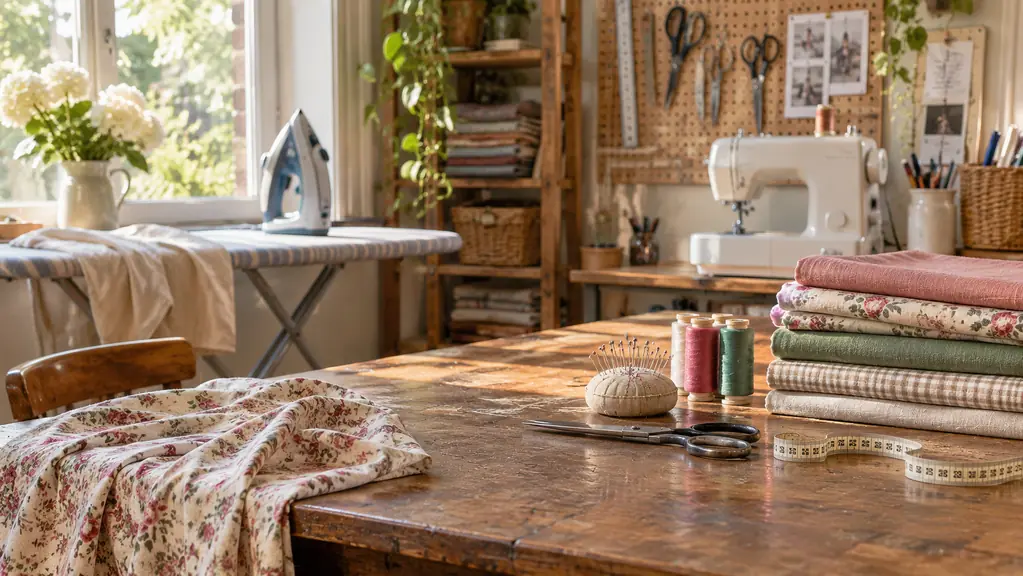
The short answer, if you want it in one breath: for the everyday work of a home sewing room, the Fiskars No. 8 Premier Easy Action Bent Scissors do more of it. Gingher shears win the one job that made their name, a long clean pass through slippery fabric. I keep both within arm's reach of my machine and I would not give up either one. But when a neighbor asks me what to buy first, I put the Fiskars pair in her hand and tell her the shears can wait for a birthday.
That answer surprises people who assume the forged shear is always the better tool. It is the better blade. It is not always the better tool for a woman with a sore thumb and forty pillowcase hems to turn. I am 74, I ran an alterations counter in a dry cleaner for twenty-two years, and my right thumb has been stiff since about 2019. What I care about now is how many times a day a tool asks me to squeeze it. Fiskars built theirs around that question. Gingher built theirs around the cut itself.
| Fiskars No. 8 Easy Action | Gingher Shears | |
|---|---|---|
| Hand effort | The spring opens the blades after every cut, so your fingers only ever close them | You open and close the blades yourself, all day long |
| Cut on slippery fabric | Straight alloy steel edge that cuts to the tip | A knife edge bears down and holds lining and silk where you put them |
| Long sessions | 4.8 ounces, light enough to use standing at the ironing board | Heavier in the hand, and your thumb knows it after ten minutes |
| Sharpening and service | Titanium-coated blades are not meant for home resharpening | Can be serviced, the edge reset, the pivot tightened, and brought back |
| Left or right hand | Ambidextrous out of the package | Made in left and right hand versions, and you must order the correct one |
| Blade length | 8 inch blades on a 10 inch scissor | A full shear with more blade out ahead of your hand |
| Safe storage | Easy-open thumb lock holds the blades shut in a drawer | No lock, the blades stay wherever you leave them |
| Best for | Trimming, clipping, snipping threads, cutting around curves and notches | Cutting out a whole garment or a quilt in long straight runs |
Where Fiskars Wins
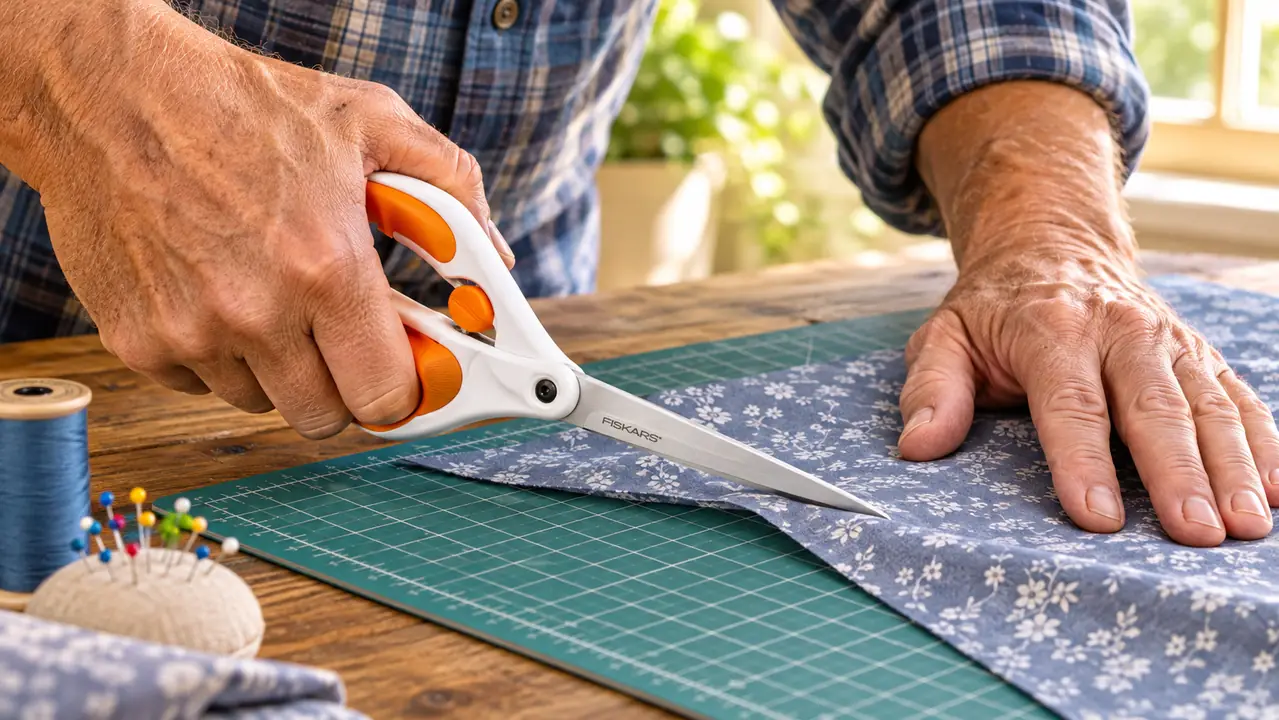
The spring. That is the whole argument and the rest is detail. The handle on the Easy Action pair is spring-assisted, so the blades open themselves after every cut. You do half the work. Close, close, close, and the tool resets in between each one. Hem four pairs of school trousers and count the squeezes. The spring does the opening half of every single one of them, and by the last hem my thumb is still speaking to me. It is not a trick and it is not a substitute for a sharp edge. It simply takes one of the two movements out of cutting.
Then there is the rest of the package. It weighs 4.8 ounces, which is light enough to hold up over an ironing board. It is ambidextrous, so it does not matter which hand picks it up. The blades are 8 inches of precision-ground alloy steel with a titanium coating, and they cut to the tip, which means I can snip a thread at the needle without turning the work around. The easy-open thumb lock slides across with one thumb, handy when the other hand is holding cloth. Round point, straight edge, limited lifetime warranty. In twenty-two years at that counter I never mailed a pair back, but I liked knowing I could.
And it is the pair a beginner should learn on. New sewists haul the blades apart with their fingers because that is what they did with the kitchen scissors. The spring trains you out of it in about a week. You learn to let the tool open, close on the fabric, and let it open again. That rhythm is what makes a cut go straight, and it is much easier to learn on a pair that helps than on a pair that does not.
Where Gingher Wins
A forged shear with a knife edge does something the Fiskars pair cannot do. The edge bears down and holds the cloth. Lay out a length of lining, the kind that slides off the table if you breathe on it, and a knife edge keeps it exactly where you put it. The Fiskars blade is genuinely sharp, but it is a straight edge, and a straight edge tends to push a slippery fabric along the table instead of pinning it down. That single difference is why dressmakers reach for shears when they are cutting out a whole garment and the pattern piece has to be exact to the thread.
Second, shears can be renewed. A good pair goes off to be serviced, the edge reset, the pivot tightened, and it comes home cutting the way it did when it was new. The titanium-coated blades on the Fiskars pair are not built for home sharpening and are not meant to be. For the work most of us do they never need it. But if you cut out a quilt every week for thirty years, a tool you can bring back from the dead is worth owning. Gingher also gives you more blade out ahead of your hand, and on a wide table with a long border to true up, that reach matters more than any spring.
Half the squeezes, on every cut you make today
Spring-assisted handles open the blades so your fingers only close them. 8 inch titanium-coated blades that cut to the tip, ambidextrous, 4.8 ounces, with a thumb lock you can work with one hand.
Amazon See the Fiskars No. 8 on Amazon →The Spring, the Lock, and My Right Thumb
I resisted the spring for a month. It felt like the tool was doing something I had not asked it to do, opening on its own, nudging my fingers apart. If you have cut with regular shears for fifty years, give it a week before you decide. What happens is that you stop noticing the spring and start noticing that your hand is not tired at four in the afternoon. My thumb used to ache by lunch on a mending day. It does not now, and that is the whole review, honestly.
The thumb lock is the part nobody mentions and everybody uses. It slides across with one thumb and holds the blades shut. That matters in a house with a cat who sleeps on whatever fabric is laid out. Pockets has never met a pinned quilt top she did not want to lie on, and I have never once worried about her finding an open blade in the drawer. Lock it, drop it in, done. When you have had a cat for nine years you learn to buy tools that close properly.
One honest word about the spring. It is not the tool for heavy work. If you are cutting through four layers of denim or the bottom of a canvas bag, you want weight and a forged edge and a lot of leverage, and the Easy Action pair will feel like the wrong instrument in your hand. It will handle denim and a couple of layers at a sensible pace, and it will do it without hurting you. A whole jeans hem in one bite is a job for the shears.
Cutting Out a Quilt Top, Start to Finish
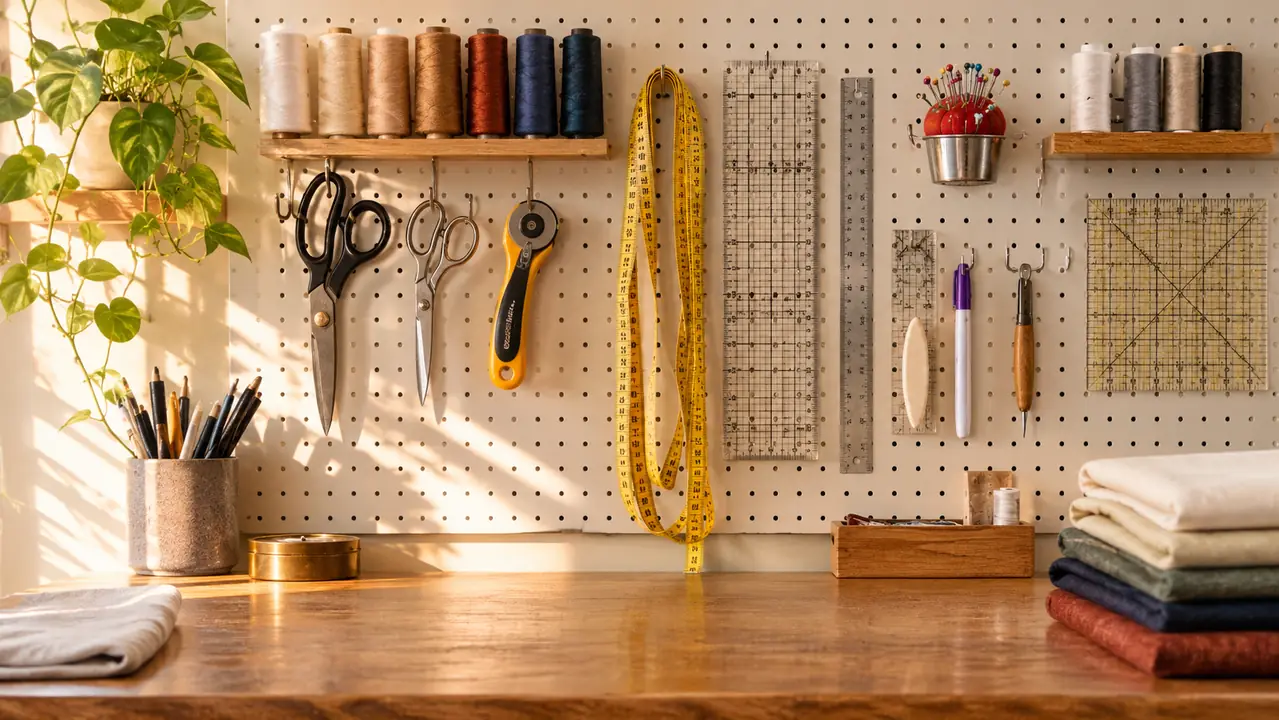
Here is the test I actually run. A crib quilt, forty by forty, nine fabrics, some starched and some not. With the Fiskars pair I cut the squares one at a time, snip the notches, and trim the dog ears after pressing. It is quick and it is easy on the hand, and the round point means I am not stabbing myself when I turn the work toward me. Where it slows down is on a long strip, a border or a binding, when the fabric wants to shift under the blade. Then I pin more and cut slower, and I get there.
With the shears, that same border comes off the table in one clean run and the fabric stays where I put it. But I have to set the work down between pieces, because a forged shear is heavy and my thumb knows it after ten minutes. So the honest answer for a home sewist is not which tool is better. It is that the two tools divide the work. Shears for the long straight runs on a fresh cut. Spring scissors for everything after that, the trimming, the clipping, the snipping at the machine, the hundred small cuts that fill an afternoon.
And then the ironing. Nobody warns you that half of cutting is pressing. I press every seam as I go and I press the fabric before it ever meets the blade, because a wrinkled length of cloth will not cut true no matter what you hold in your hand. The scissors you can use while standing at the board, one handed, without setting anything down, those are the ones that earn their place. That is the Fiskars pair for me, and it is not a close call.
What I Liked
- Spring-assisted handle opens the blades for you, so each cut costs half the hand movement
- Ambidextrous, so it works in either hand without swapping tools
- 8 inch blades cut to the tip, which makes thread snipping and notch clipping easy
- 4.8 ounces, light enough to use standing at the ironing board
- Easy-open thumb lock you can work one handed
- Limited lifetime warranty from Fiskars
Where It Falls Short
- The spring takes about a week to get used to if you learned on regular shears
- A straight blade edge pushes slippery lining rather than holding it flat
- Titanium-coated blades are not meant for home resharpening
- Not the tool for cutting through four layers or a heavy canvas seam
Hem four pairs of school trousers and count the squeezes. The spring does the opening half of every one of them.
Who Should Buy Which
Buy the Fiskars No. 8 Easy Action first if you sew in bursts, if your hands ache, if you have arthritis or tendon trouble, or if you are left-handed and tired of hunting for left-hand shears. It is also the pair I would hand a beginner, because the spring teaches you to let the tool open instead of hauling the blades apart. It handles paper, silk, denim, and a couple of layers at a sensible pace, and it does the small work that fills most of a sewing day. For the mending and hemming most of us actually do, it is the busier tool by a wide margin.
Buy Gingher shears if you cut out garments or quilts regularly, if you work with slippery fabrics, and if you are willing to look after a tool. Get the correct hand, and do not talk yourself into the wrong one. Have them serviced when they start to chew instead of cut. If you can only buy one and you sew twice a month, the Fiskars pair will do more of what you actually do. If you cut for hours every week, buy the shears and a cheap pair of snips for the thread. Very few of us need both on the same day, but most of us eventually end up with both in the drawer.
Care Notes, and What I'd Skip
Wipe the blades, do not wash them, and dry them if the room is damp. Keep the lock on in the drawer. Do not cut wire, staples, or the matted fur behind a cat's ears with the good pair. And do not send the titanium-coated blades out for a home sharpening job, because there is nothing wrong with them and a careless sharpener can make a good edge worse. A drop of oil at the pivot once a year is the whole maintenance schedule.
What I would skip is the matching set. You do not need three pairs of the same scissor in three sizes. One Easy Action pair by the machine, one pair of shears for cutting out, and a small snip on a chain at the ironing board will cover everything a home sewist does in a year. The rest is drawer clutter, and the drawer is where good tools go to rust. Buy the one you will reach for on a Tuesday afternoon when the hem is half done and the light is going.
The pair I put in a beginner's hand
8 inch titanium-coated blades, spring-assisted handles, 4.8 ounces, ambidextrous, with a thumb lock that keeps it shut in the drawer. If you sew in bursts and your hands complain, start here.
Amazon View the Fiskars No. 8 on Amazon →