
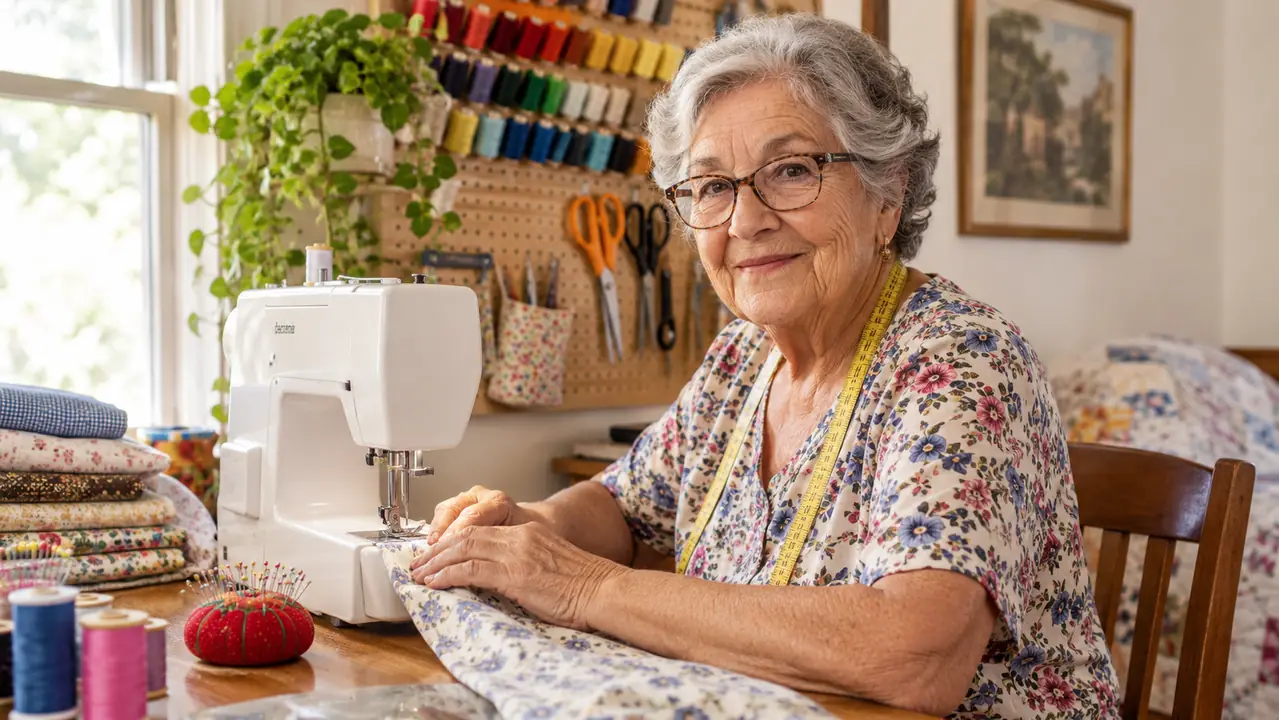
People ask me this at the counter, so here is the short answer. For the sewing most people actually do, which is mending, hemming, quilting, and the occasional dress for a grandchild, the Brother XM2701 is the better machine. The Singer Heavy Duty is the better machine for one specific job, and if that job is yours, nothing else in this class will satisfy you.
I am Winifred Coyle, Winnie to everyone who knows me. I ran an alterations counter out of a dry cleaner in Lakeland, Florida for twenty-two years, and before that I sewed for neighbors out of a spare bedroom much like the one I still work in. My right thumb has a touch of arthritis and it has opinions. So when I put a Brother against a Singer Heavy Duty, I am not reading a spec sheet at you. I am telling you which one I would still be reaching for six months in, and where the other one would beat it.
| Brother XM2701 | Singer Heavy Duty | |
|---|---|---|
| Punching through denim | Gets through light denim with a fresh needle and a patient foot | Built for it, that is the entire point of the machine |
| Weight and stability | 12.6 pounds, light enough to lift to a shelf | Heavier, and it stays put when you feed thick layers |
| Stitch menu | 27 built-in stitches, including decorative and blind hem | Utility and stretch set that changes with the model in the line |
| Needle threading | Automatic needle threader on the machine | Automatic on some models in the line, manual on others |
| Feet in the carton | 6 sewing feet, plus darning plate, twin needle and 4 bobbins | A smaller set on the entry models, more as you move up |
| Noise and vibration | Quieter on light fabric, less shudder through the table | Louder, and you will hear it through a floor |
| Footprint | 12.6 pounds, listed at 15.3 inches deep by 5.86 wide by 12.01 high | Heavier and deeper, it wants a permanent spot |
| Warranty | The listing states no warranty | A limited warranty measured in years, not months |
| Best for | Mending, hemming, quilting, everyday garment work | Denim, canvas, bag making, thick seams over and over |
Where the Brother XM2701 Wins
Start with the needle threader, because that is the feature I would pay for on its own. The XM2701 threads the needle for you. At seventy-four, with a thumb that does not pinch the way it used to, I can thread that machine without my glasses, without a second attempt, and without the small prayer I used to say over a manual needle. If you have ever stood over a machine at nine at night holding a limp thread and squinting at an eye you cannot quite see, you know exactly what that is worth. It is not a beginner feature. It is a feature for anybody whose hands are tired.
Then the stitch menu. Twenty-seven built-in stitches, and the ones that matter to a home sewist are all in there: a blind hem for skirt hems and trouser cuffs, a stretch stitch for knits, and a run of decorative stitches for quilt borders and the yokes on little girls' dresses. I have used maybe eleven of the twenty-seven in a serious way. But the blind hem alone has saved me more hours than any other feature on the machine, because a hand blind hem on a wool skirt is forty minutes and a machine blind hem is six.
Take the gray wool A-line skirt that came to me last October with the hem let down and a crease pressed hard across the fold. An inch and a quarter of hem allowance, pressed flat and pinned on the board by the window, is a forty minute job by hand and a six minute job on the machine with the blind hem foot that comes in the carton. The stitch catches a thread of the wool and then disappears into it. I had that skirt finished, plus two pairs of trousers taken up, before lunch, and I spent the afternoon on a quilt border instead of on my knees over a hem. That is the honest case for the Brother, and it has nothing to do with how many stitches are printed on the dial.
The carton is generous too. Six sewing feet, a darning plate, a twin needle, four bobbins, a needle pack, a screwdriver, and the manual. That is not a marketing list, that is a working kit. The darning plate means you can drop the feed dogs and freehand mend a worn elbow or the knee of a pair of jeans, which is half of what people bring me. And the whole thing weighs 12.6 pounds, so I can lift it off the table and onto the shelf when the grandchildren visit and the spare room has to be a bedroom again.
At seventy-four, with a thumb that does not pinch the way it used to, I can thread that machine without my glasses and without the small prayer I used to say over a manual needle.
Where the Singer Heavy Duty Wins
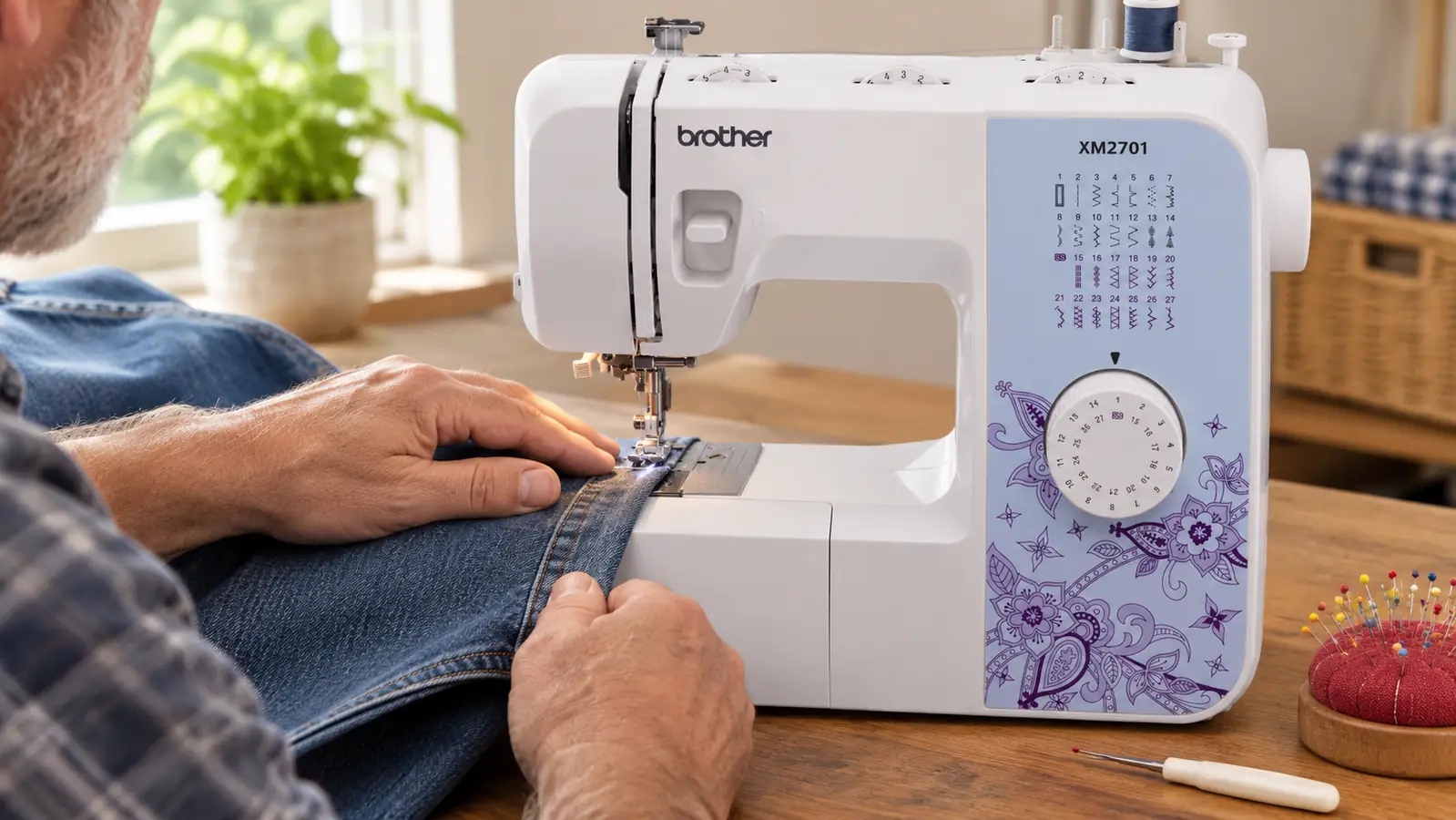
Now the honest half. The Singer Heavy Duty is heavier, and that weight is not a design flaw, it is the feature. A heavier machine does not walk across the table when you push eight layers of denim under the foot. It does not shudder when the needle meets a flat felled seam on a pair of work jeans. For bag makers, for people who sew canvas totes and upholstery weight fabric and denim skirts with real seams in them, that mass and the metal frame behind it are the difference between a seam that runs true and one that wanders off the line.
I have a neighbor who brings me her husband's work jeans twice a year, four pairs at a time, every one of them blown out at the knee or split along the back pocket. On the Brother I get through them with a fresh jeans needle, a slow foot and a certain amount of patience, and I will not pretend I enjoy it. The needle flexes, the machine shifts, and I stop and reset twice a pair. On a heavier machine that same seam runs through without the flex and without the walk. If that twice a year job were a twice a week job, I would own the heavier machine and I would not think twice about it.
And the warranty. The Brother listing states no warranty at all, which is worth knowing before you buy rather than after. Singer publishes a limited warranty measured in years. If you are the sort of person who wants a company on the hook for a decade, that matters, and I am not going to pretend it does not. I have watched a machine go back to a manufacturer on a warranty claim exactly once in twenty-two years, and the woman who owned it was very glad of the paperwork. It is not the reason to buy a machine. It is a reason to feel settled about the one you bought.
The machine I would put in a spare bedroom
The Brother XM2701 threads its own needle, weighs 12.6 pounds, and ships with six feet and a darning plate. For mending, hemming and quilting, that is the whole of what a home sewist needs.
Amazon Check Today's Price on Amazon →The Tension Question, Since You Asked
Thread tension is where most people blame the machine for something the machine did not do. If your stitches are looping underneath, the first thing to check is not the dial, it is whether the presser foot was up when you threaded. The second thing is whether the bobbin is wound evenly and seated the right way. The third is whether your needle is dull. I have rescued more machines with a fresh needle and a rethread than with any adjustment to the top tension, and I have never once regretted starting there.
A neighbor brought me a jersey knit dress in the spring with a hem that was looping underneath like a row of tiny beads. She had already turned the top tension down twice and was ready to give up on the machine and buy a new one. The real problem was that she had threaded it with the presser foot down, so the thread never seated between the tension discs at all. We rethreaded with the foot up, put in a fresh needle, switched to the stretch stitch, and the hem ran clean on the first pass. Ten minutes, no parts, no repair shop, and she still has the machine.
The XM2701 has a top tension dial and a drop in top bobbin, and that bobbin is a genuine convenience. You lift the cover, drop it in, run the thread through the slot, and you are done. No bobbin case to remove and no shuttle to fish for. For a home sewist working in short sittings between other jobs, that is the difference between starting a hem and deciding to do it tomorrow. Machines with fiddlier bobbin access get used less, and a machine that gets used less is a worse machine no matter what the box promised.
Where They Are Evenly Matched
Both machines will sew a straight seam. Both will hem a pair of trousers, take in a waistband, and put a zipper in a cushion cover. If that is the whole of your sewing life, the difference between them is convenience rather than capability, and you should buy the one that feels better under your hands. Do not let anybody shame you into the heavier machine because it sounds more serious. Serious is whatever gets you to sit down.
Both come with a manual, and both reward the same habits: a fresh needle every eight or ten hours of sewing, the presser foot up when you thread, the top tension adjusted in small steps instead of big ones, and a press with an iron between every seam. Pressing as you go will improve your sewing more than any machine upgrade you can buy, and it costs you the price of an ironing board you probably already own. Both will also sit untouched for three weeks and then take three jobs in one weekend. That is normal, and it is not a sign you bought the wrong thing.
The One Thing I Would Check Before Buying Either
Sit down at the machine if you can, and not just to sew a test seam. Reach for the controls. Where is the reverse lever, and can you find it without looking down? Where does the bobbin go, and can you get the cover off with the hand you actually have? My thumb complains, and I have walked away from machines that were perfectly good on paper because a lever sat where my hand did not want to go. That is not fussiness. That is fifty years of knowing which machine I will still like in March.
I went with a neighbor to a shop in town last year while she chose between two machines sitting on the same shelf. Both had good reviews. Both sewed a straight seam on the shop's scrap fabric without complaint, and neither one did anything wrong. She bought the one where the reverse lever fell under her index finger without her having to look for it. The other had the better stitch count, and she would have fought it every time she backstitched, which is every seam she sews. She has not once regretted it.
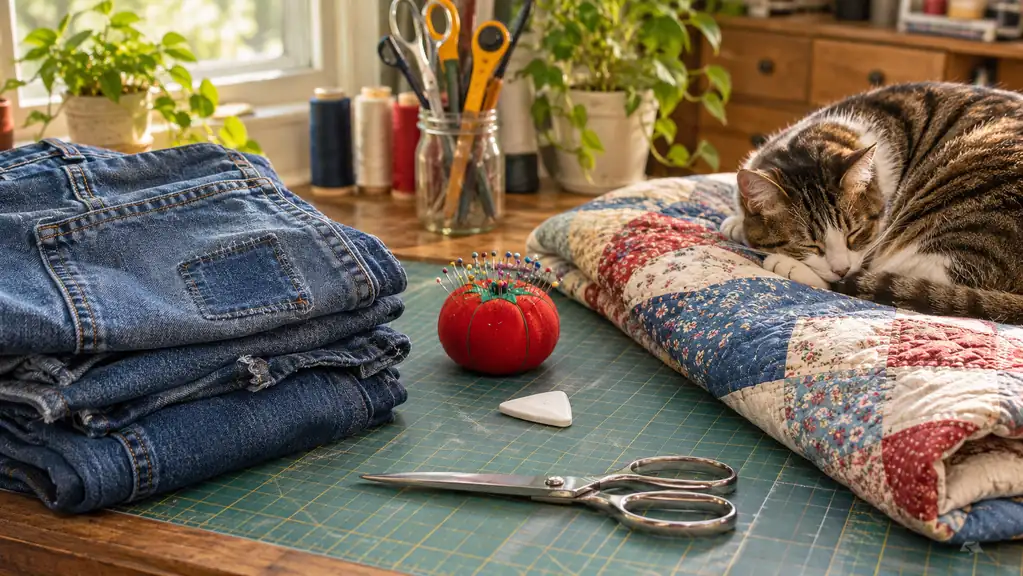
Second, decide whether the machine has a permanent home. My spare bedroom holds a cutting table my late husband built out of an old door, an ironing board by the window, and a pegboard wall of tools. Pockets, my gray tabby, naps on whatever fabric I have laid out, so covered storage and a lint roller live within reach of that table. A 12.6 pound machine lives on the table and goes on the shelf when it has to. A heavier machine wants to stay out. If it has to go into a closet every single time, you will sew less, and that is the whole ballgame.
Who Should Buy Which
Buy the Brother XM2701 if your sewing is mending and hemming for the household and the neighbors, quilts for the grandchildren, the occasional dress or skirt, and small repairs that arrive in a bag on a Sunday afternoon. Buy it if your hands are not what they were, because the automatic needle threader and the 12.6 pound weight do real work for you every time you sit down. Buy it if the machine has to share a room with a guest bed. For a fuller picture of how it holds up over months rather than an afternoon, there is a long term review worth reading before you commit.
Buy the Singer Heavy Duty if you sew denim, canvas, or upholstery fabric on purpose and often. If you make bags, if you are the person in the family who gets handed the work jeans, and if the machine has a table it can live on, the extra weight is working for you instead of against you. Buy it if a multi-year warranty is the thing that lets you sleep at night. And if you are still deciding whether a plainer machine suits you at all, the case for a simple machine in a home sewing room is stronger than most people expect.
One last thing before you decide
Whichever you pick, order a fresh pack of needles with it. A dull needle causes more skipped stitches and pulled threads than any tension problem, and nobody believes that until they change one.
Amazon Check Today's Price on Amazon →