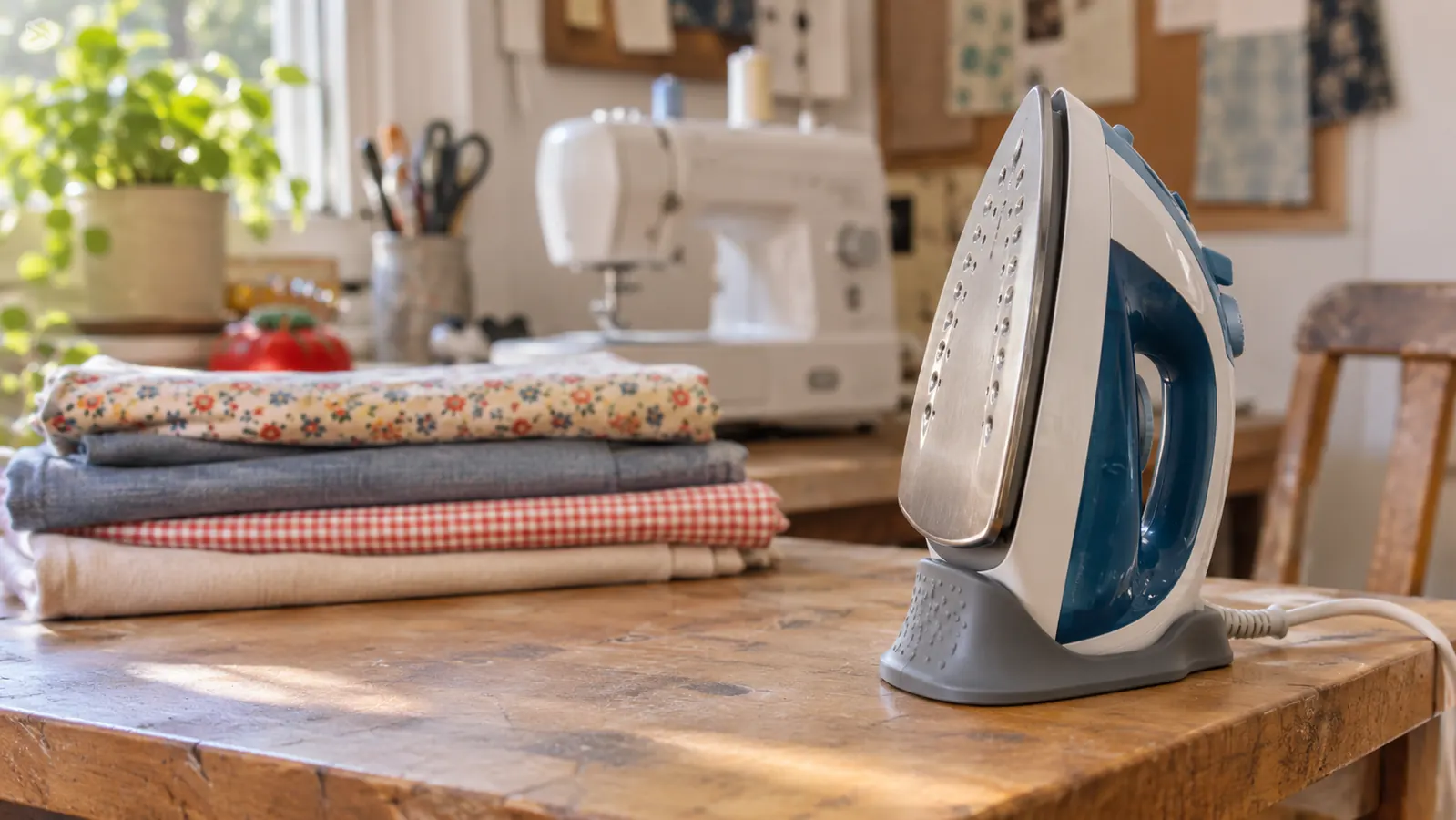
The first thing nobody tells you about a mini iron is that it will not replace the iron you already own. The second thing is that you will stop walking over to that iron anyway. I have had the oliso M2Pro at the end of my cutting table since the spring, and the big iron on the board by the window has gotten a little lonely. Not because the small one does more. Because it is already at my elbow, warm, when both my hands are full of a seam.
So this is the honest version of the review, the one where the drawbacks get the same room as the good parts. The oliso M2Pro carries more than three thousand ratings on Amazon and sits at about four and a third stars, which tells you most buyers are content with it. What that does not tell you is whether it suits the way you sew. That comes down to three things: how much space you have, how much grip your hands can manage on a given afternoon, and whether you truly press as you go or save it all for the end of the project.
The Quick Verdict
A genuine second iron for the sewing table, with a rest that earns its keep and a steam habit you have to learn. Not the iron to own if it would be your only one.
Amazon Check Today's Price →The iron that is already hot by the time the seam reaches the board
Forty five seconds from cold to ready, a silicone rest in the box, and a soleplate that sits beside the machine instead of across the room.
Amazon Check Today's Price on Amazon →How I Have Actually Used It
I spent twenty two years at an alterations counter in a dry cleaner, hemming other people's trousers, and I have owned a great many irons in that time. These days I work from the spare bedroom, at a cutting table my late husband built out of an old door, with the ironing board by the window. Most of what I do is mending and hemming for neighbors, quilts for the grandchildren, and the occasional dress for myself. That work is small, repetitive, and made of short seams, which is exactly the work a mini iron suits.
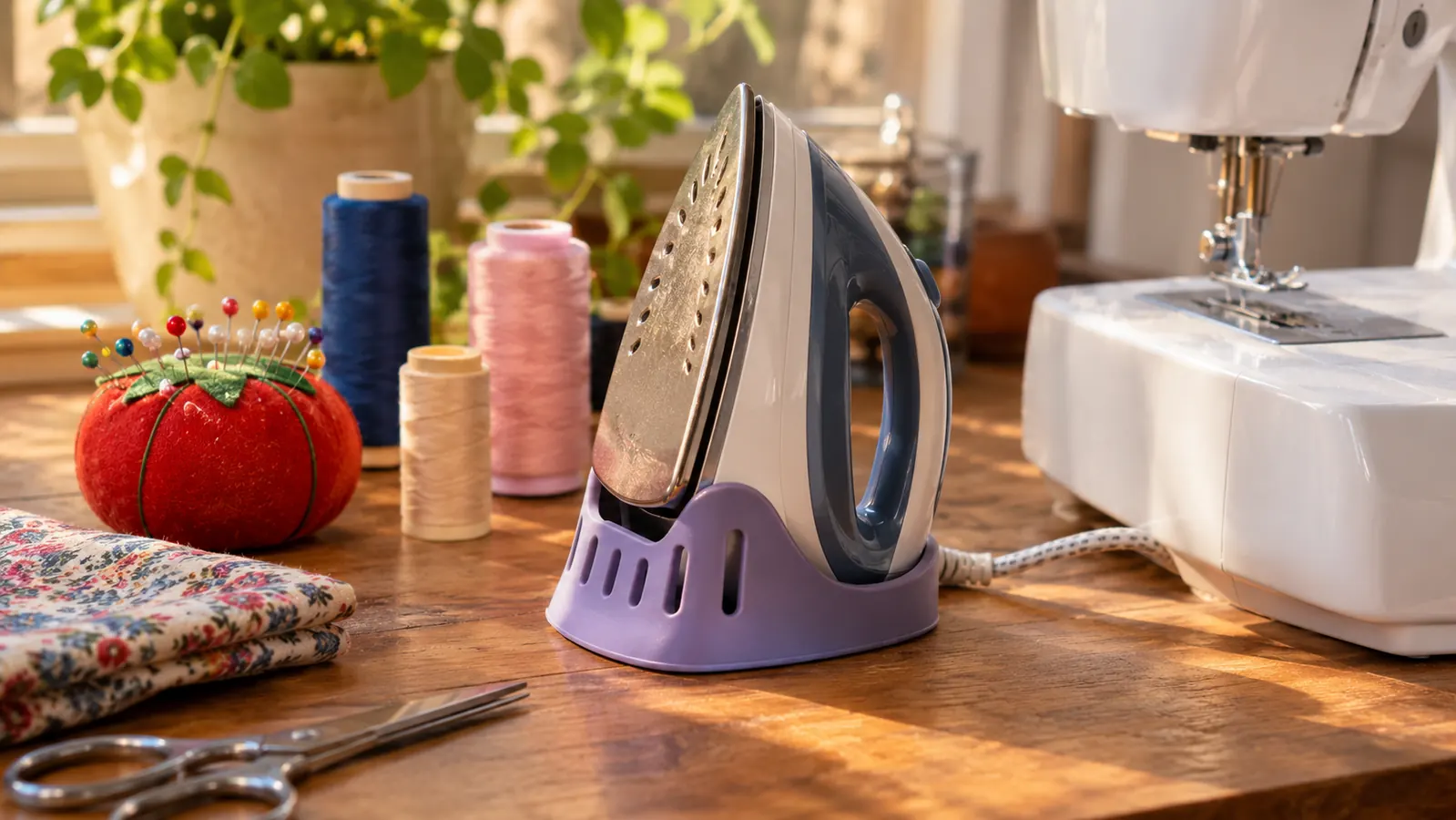
Mine lives on the Solemate rest that comes in the box. It is a silicone cradle and it does one job: it gives the hot soleplate somewhere to sit that is not your fabric, your table, or your knee. On a full size board you never think about this. On a cutting table with a quilt sandwich laid out across it, you think about it every half minute, and the rest has turned out to be the part I would miss most if it went missing.
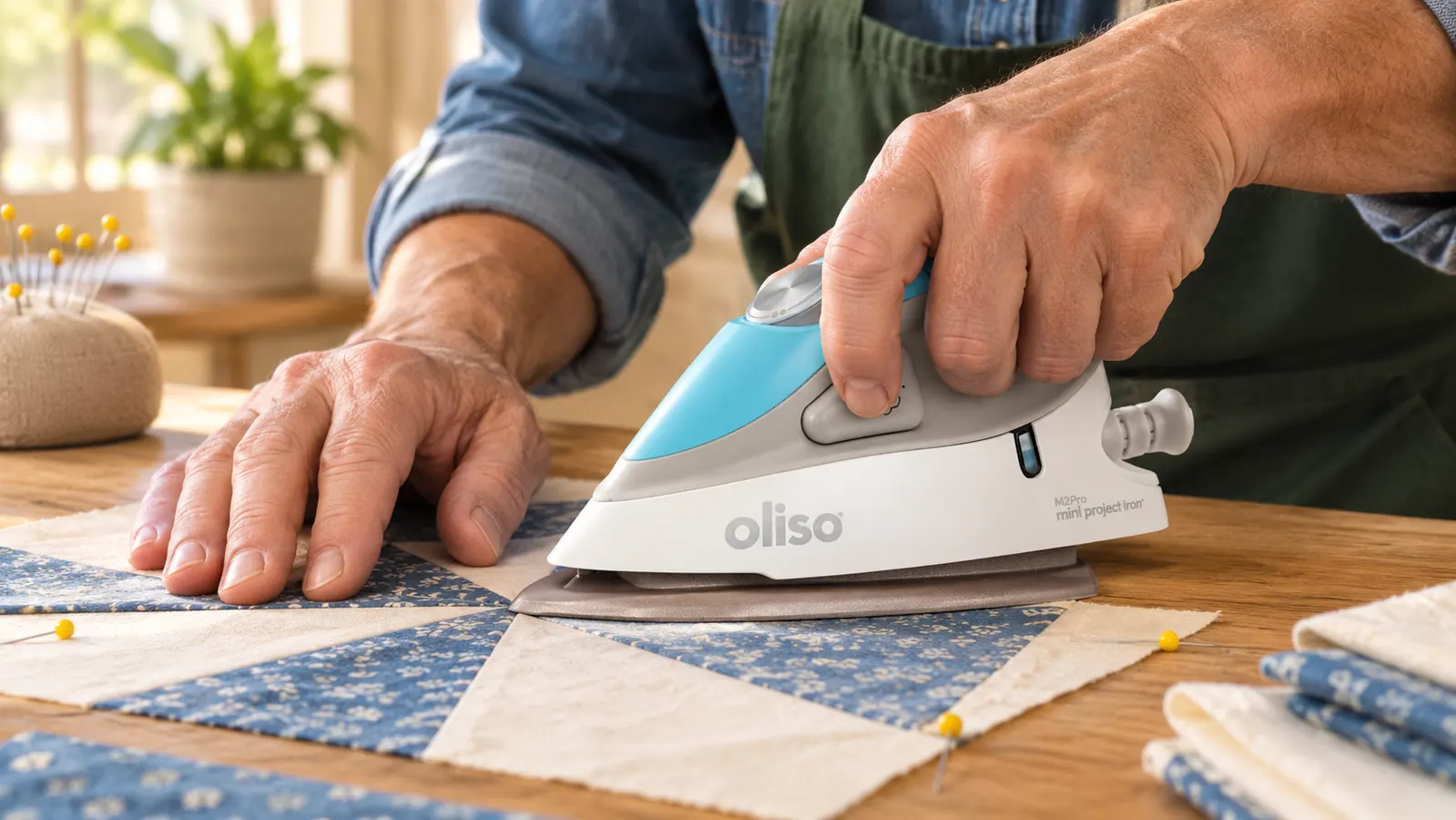
The other thing I noticed early is the grip. I have arthritis in my right thumb, and a full size iron at the end of a long afternoon starts to feel like a brick on a stick. At about a kilogram, the oliso is light enough that I can hold it in one hand while the other hand keeps the seam where I want it. That sounds like a small thing to anyone with good hands. It is not a small thing to me.
An example from a Tuesday in June, because that is the sort of proof I find more useful than a spec sheet. A neighbor brought over four pairs of trousers to shorten, all of them the same thirty inch inseam, all of them a wool blend that scorches if you look at it sideways. Twenty two years at the counter taught me to press hem creases on the wrong side with a cloth, and I did that at the cutting table with the oliso, one leg at a time, turning each trouser as I went rather than carrying four pairs over to the board. The whole job took me an hour and ten minutes. Had I done it the old way I would have spent twenty of those minutes walking back and forth to the big iron, waiting for it, and losing track of which leg was which. That is the trade, and it is the trade nobody puts in a listing.
What Nobody Tells You About a Mini Iron
Here is the first truth. You are trading coverage for control. The soleplate on a small iron is narrow in absolute terms, and narrow means you press a seam, not a yardage. The oliso listing calls the soleplate wide and says the heat is even across it, and in use that holds up. I have not found a corner that scorches while the middle stays cool, which is more than I can say for a cheap travel iron I once bought at a hardware store. But wide for a mini iron is still narrow. If you are pressing a curtain panel, you will be at it all morning.
The second truth is that the steam is a small iron's steam. There is a fabric selector dial, and there is on demand steam, which means you press the button when you want a burst rather than holding a trigger the whole time. For cotton seams and quick creases it is plenty. For heavy linen, or a wool coat you are easing back into shape, you will want the big iron, a damp cloth, and a bit of patience. No amount of wishing changes that.
Before this one I tried a folding travel iron that cost less than a good lunch and was worth about that. The plate was fine, but the whole thing was top heavy, so it tipped whenever I set it down, and it never got hot enough to press a cotton seam flat, only warm enough to encourage it. I gave it to a neighbor who does not sew. What the oliso has that it did not is weight in the right place, down low where it holds the fabric, plus a rest that takes the whole hot face without tipping. That is not a small difference when your thumb is sore and your other hand is holding a seam allowance open under the needle.
The third truth is the forty five second heat up, and that number is the whole argument for the tool. It sounds like a line from a listing until you build a habit around it. I switch the oliso on, carry the seam from the machine to the board, and it is ready when I get there. Years ago I would press four seams at once at the end of a project, because heating the big iron felt like a commitment I did not have time for. Now I press each one as it comes off the needle, and my points have gotten better for it.
Forty five seconds is the entire case for this iron. By the time I have turned from the machine to the board, the oliso is ready and I have not lost my place in the seam allowance.
The Cord, the Voltage, and the Dial
The cord is eight feet and it pivots at the base, which matters more than it sounds in a room with one outlet in an awkward place. Eight feet reaches the socket behind the board without an extension lead trailing across the floor where the cat naps. The pivot means the cord hangs where it wants to hang instead of dragging the iron off line every time I set it down. Small engineering. Real difference in a room that was never designed for sewing.
Dual voltage, one twenty and two forty, is the feature I have used least and appreciate most. Two springs back I took a class at the quilt shop in town and carried the oliso in my bag, and it worked on the shop's power with nothing else needed. If you travel, or take classes, or sew with a group once a month, that is a real convenience. If you never leave the house, you have paid for something you will not use, and it is fair to say so plainly.
The fabric selector dial is a plain dial marked for synthetics, silk, wool, and cotton. It is not a temperature readout and it will not tell you a number of degrees. You learn it the way you learn any iron, by testing on a scrap of the same fabric before you commit a real seam to it. I keep a strip of every fabric I use often pinned to the wall behind the board, and those strips are what I test on. That habit has saved me more fabric than any feature on any iron.
Where the oliso M2Pro Falls Short
Now the part the listing does not lead with. This iron will not press a quilt flat. I piece at the machine and then the top needs a proper pressing before it goes on the frame, and for that I roll out the board and bring out the big iron, because a small soleplate dragged across a sixty inch top is an exercise in patience I no longer have. Budget for keeping both irons. That is the honest bottom line, and anyone who tells you otherwise is selling something.
I learned that the expensive way on a lap quilt for my granddaughter, a simple nine patch that needed a proper pressing before it went on the frame. I tried to do it on the cutting table with the oliso because the big iron was cold and the board was folded behind the door. What I got was a top with soft spots and one seam that had curdled, because I pushed the small plate along it instead of pressing down and lifting. I ended up pulling out three rows of quilting stitches and doing them again. Nothing was ruined, and the quilt went to her at Christmas. But the lesson stuck: small iron for seams, big iron for the top, no exceptions.
The second shortfall is water. A small iron holds a small amount, so you will refill it more often than you refill the big one. On a hemming afternoon it never bothers me. Halfway through a dress with a great deal of seam pressing, I notice it. If you sew in long stretches, keep a small pitcher at the table so that refilling is one motion instead of a walk across the room and a decision about whether to bother.
The third is that it does not do anything for you. You set the dial, you wait the forty five seconds, you press the steam button, you set the iron back on its rest. The last thing I do before I leave the room is pull the plug, because a hot soleplate near fabric is the one mistake I have made often enough to respect. If you want an iron that manages itself while you are distracted, this is not that iron, and I would rather tell you now than have you find out.
The warranty runs three years from the manufacturer, which is respectable for a small appliance, but keep the receipt somewhere you can actually find it. I write the date on the end of the box in marker, the way I do with everything that might need returning, because in fifty years of buying things I have never once produced a receipt on demand.
What I Liked
- Heats in forty five seconds, which turns pressing as you go from a virtue into the easy option
- Solemate silicone rest included, and it is the reason this iron can live on a cutting table at all
- About a kilogram, light enough to hold in one hand with arthritis in the thumb
- Eight foot pivot cord reaches the outlet without an extension lead across the floor
- Dual voltage for classes, travel, and sewing groups
- Even heat across the soleplate with no scorched corners
- Three year manufacturer warranty
Where It Falls Short
- Will not press large pieces, so you will keep a full size iron alongside it
- Small water capacity means refilling partway through a long project
- The fabric selector is a dial with names on it, not a temperature, so you test on scraps
- Steam is modest, and heavy wool or linen still wants the big iron and a damp cloth
- Nothing is automatic, so unplugging it is a habit you have to build
What It Changed About My Sewing
I did not expect a small appliance to alter my habits, and it would be overstating things to say it did. What it changed is smaller and more useful than that. I press more often. I press shorter seams that I used to skip. I press the seam I just sewed instead of stacking four of them and dealing with the pile later, and the work coming off my machine sits flatter because of it. That is not the iron being clever. It is the iron being close, and closeness is most of the battle at a sewing table.
It also made my setup smaller. The board stays folded against the wall most days now, because the oliso and its rest take up a corner of the cutting table and nothing more. In a spare bedroom that has to hold a machine, a table, a pegboard of tools, and a cat who believes every laid out piece of fabric is a bed, the difference between a folded board and an open one is the difference between sewing today and not.
There is one more change, and it is the sort of thing that only shows up over months. My scrap bin has grown. I press small test pieces now where I used to guess, a two inch square of the actual fabric with the actual interfacing fused to it, because the iron is already hot and it costs me nothing to check. Twice this year that habit caught a heat setting that would have left a shine on the finished piece, once on a polyester blend for a dress and once on a scrap of silk I had no business pressing without a cloth. Fifty years of sewing and I am still learning to test first. The oliso just made testing cheaper than not testing, and that is about the highest compliment I can pay a tool.
Who This Is For
This is for the person who already owns a decent iron and wants a second one within arm's reach of the machine. It suits quilters who press every seam as they piece, dressmakers working short curved seams and darts, and anyone hemming at a table rather than standing at a board. It suits small rooms, shared rooms, and anyone whose sewing space has to be packed away at the end of the day, since the rest means you are not holding a hot iron in the air while you decide where to put it.
Who Should Skip It
Skip it if this would be your only iron. Skip it if you press yardage, curtains, quilt tops, or anything you have to move across a board in long strokes, because you will spend the whole time wishing the soleplate were twice the size. Skip it if you want to fill the water once and forget it. And skip it if you would rather not think about a hot tool sitting on a table in a house with a cat in it. My gray tabby has walked across a laid out quilt more than once, and the reason the rest matters here is that I do not entirely trust myself at the end of a long afternoon.
Buy it as the second iron, not the only one, and it will earn its corner
The oliso M2Pro suits a small sewing room and a press as you go habit. If you press yardage, keep your big iron too.
Amazon Check Today's Price on Amazon →