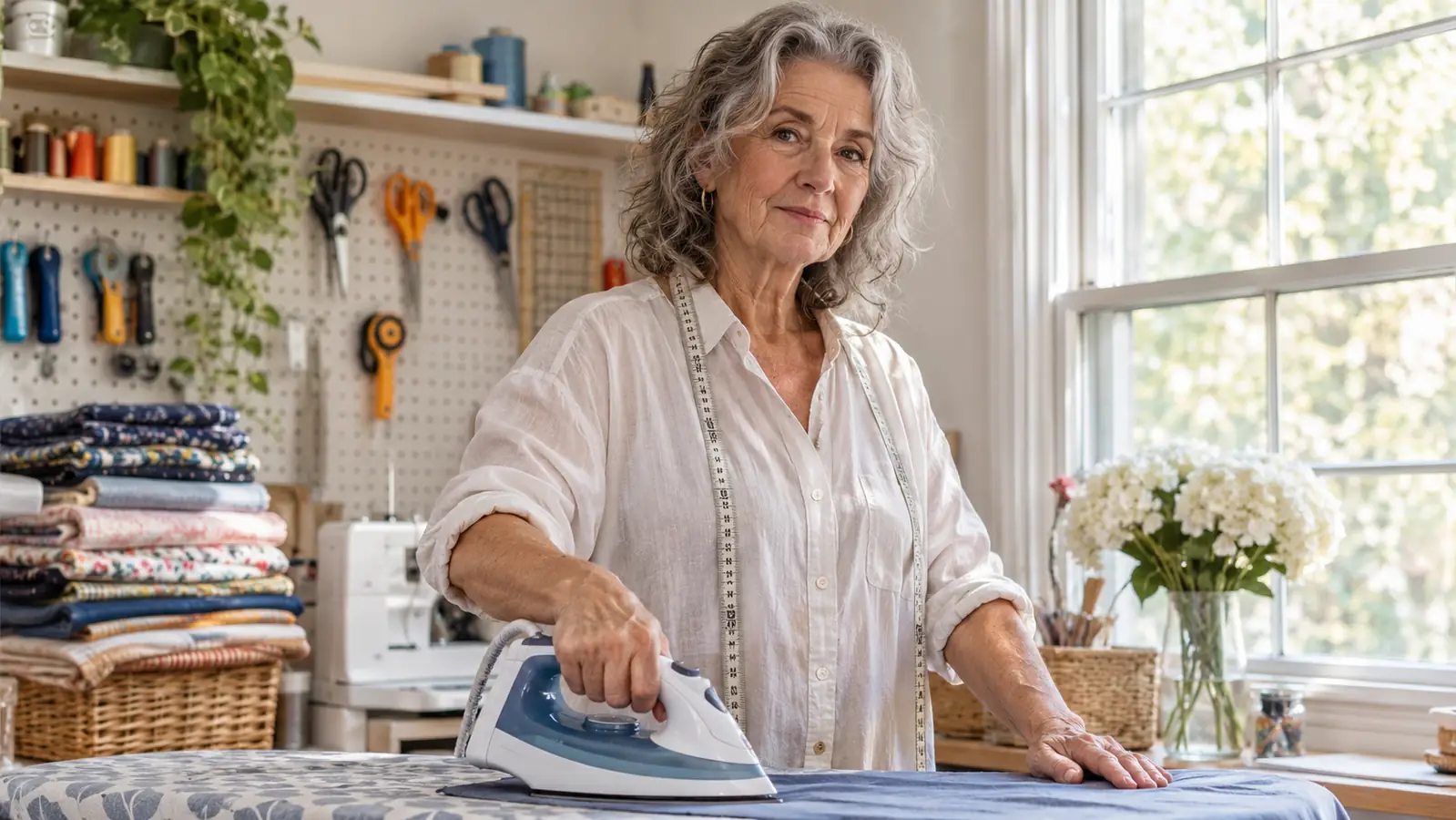
Four neighbors have asked me the same question since spring, and it comes out roughly the same every time: Winnie, do I really need one of those little irons, or am I just collecting gadgets? I have pressed at the same board by the window for a long while now, with a door turned cutting table behind me and a cat who believes every piece of cotton is a bed. So I have a short answer and a long one.
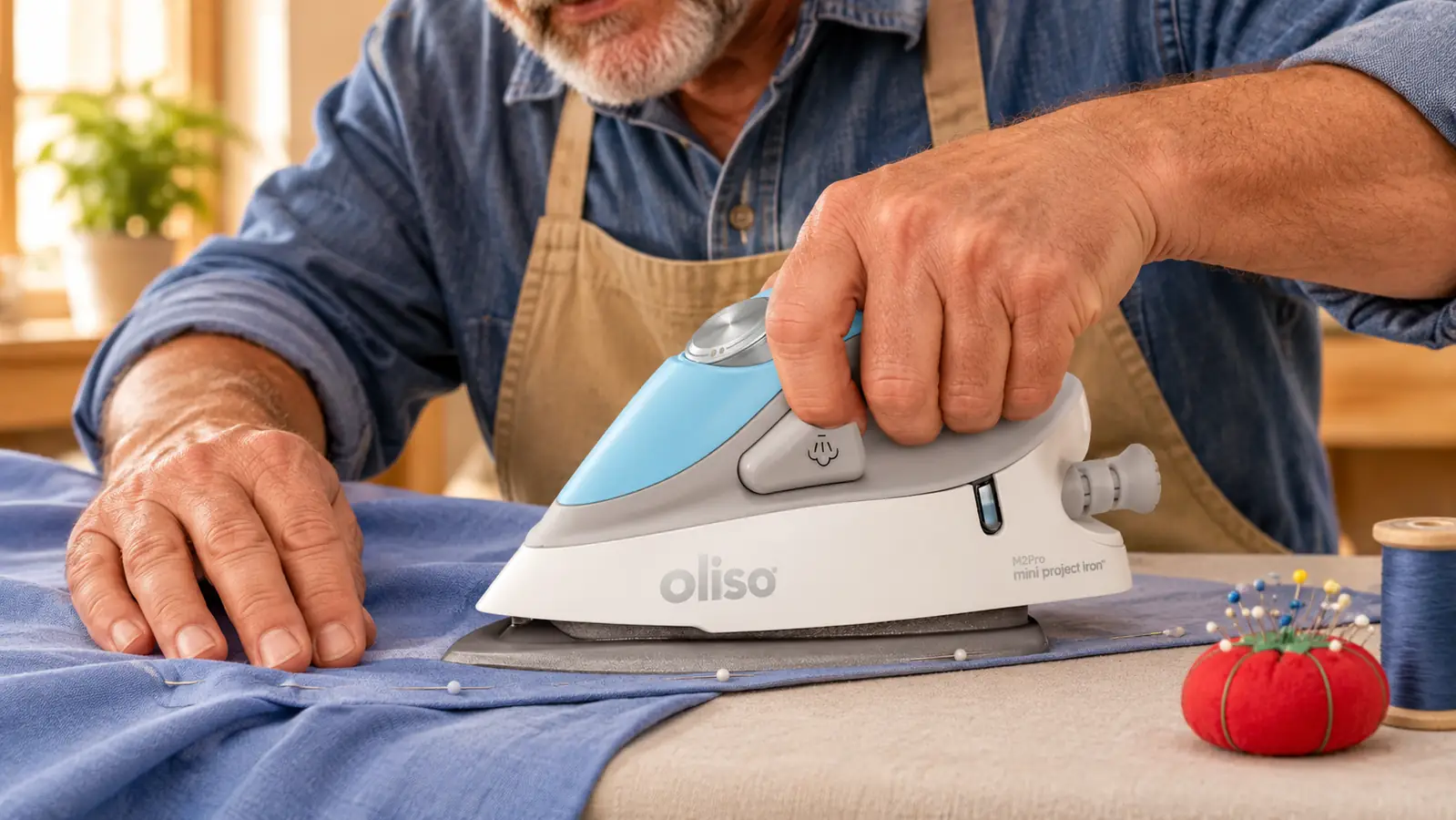
Here is the short one. They are two different tools and neither replaces the other. The oliso M2Pro Mini Iron is the one that belongs beside the needle, because it heats in 45 seconds, it sits within arm's reach, and it never has to be carried anywhere. A full-size iron belongs at the end of the board when the job is a quilt back, a curtain panel, or a stack of hemmed trousers, and you want weight and water doing the work instead of your shoulder. If you have room for both, keep the mini at the machine and the big one folded against the wall, and you will use both more than you expect.
| oliso M2Pro Mini Iron | Full-Size Iron | |
|---|---|---|
| Footprint at the machine | 10 by 5 inches, so it lives beside the needle and never gets put away | Needs a board and a clear path to it, so it tends to stay in the closet |
| Time to temperature | 45 seconds from cold | A minute or more, and longer on an old iron |
| Steam and water capacity | Steam on demand from a small tank, refilled often | Big tank and steady steam through a long seam |
| Large flat work: yardage, quilt backs, curtain panels | Gets there in overlapping sections | Covers the width in fewer passes |
| Freshening a finished garment on the hanger | Not what it is built for | Tank and steam do the work while the garment hangs |
| Small work: darts, cuffs, curved seams, doll clothes | The small plate gets into the curve and stays there | The plate overhangs and puts creases where you do not want them |
| Weight in the hand | 1 kg, about 2.2 pounds, easy to lift and carry | Heavier, and that weight does the pressing for you |
| Setting it down mid seam | Solemate silicone rest included, so there is a place for it | Needs a stand or a clear end of the board |
| Cord | 8 foot pivot cord swings clear of the fabric | Similar length on most models, stiffer with age |
| Sewing class and travel | Dual voltage 120/240 and small enough for a tote | Stays home |
| Cost | A premium for a small iron | Runs from budget to very good, and you may already own one |
| Warranty | 3 year manufacturer warranty listed | Varies by model, so read the terms |
Where the oliso M2Pro Wins
Start with the waiting, because the waiting is what kills the habit. Pressing as you go only works if pressing is easier than not pressing. A full-size iron takes a minute or better to come up to heat, and longer if it has been sitting cold since last winter, so the seam gets sewn and the pressing gets postponed and by evening you are pressing a finished garment instead of building it. The oliso is at temperature in 45 seconds. In practice that means I press the seam I just sewed while the next piece is still under the needle, and the work never gets ahead of me.
The second win is the footprint. The oliso M2Pro is listed at 10 inches long by 5 inches wide, which lets it live on the corner of the cutting table without taking the corner. Its cord is an 8 foot pivot cord, so it swings out of the way instead of dragging across the fabric while you turn a seam. And it comes with the Solemate silicone rest, which matters more than it sounds like it should, because there is a designated place to set a hot iron down instead of balancing it on the edge of the board and hoping.
One more thing worth saying plainly. 1000 watts in a small package is not a steam monster, and it does not pretend to be. What it buys you is speed to temperature and enough heat to press a folded seam flat in one or two passes. Do not expect it to blast the wrinkles out of a linen tablecloth. Expect it to be ready when you are, every time, sitting six inches from your hand when the seam comes off the machine.
Where the Full-Size Iron Wins
Water and steam, first and plainly. A full-size iron carries enough water to steam through a long seam, a wool crease, or a whole pair of trousers without a refill. The mini holds what a mini can hold, and on a heavy pressing job you will be walking to the sink more often than you would like. When I am setting a crease in wool I want steady steam for a minute at a time, and that is a big iron job. There is no way around it and no clever workaround I have found in fifty years of trying.
Weight is the other one, and I mean it as a compliment. A full-size iron presses with its own mass. You lay it down, let it sit, and the fabric flattens. With a small iron you supply the pressure yourself, which is fine for a dart and tiresome for a quilt back. Anything with real square footage to it goes faster and flatter under the big iron: a backing, a curtain panel, a tablecloth hem. Same story for freshening a finished coat on the hanger, where the tank and the steam do all the work and your wrist does none of it.
If the pressing happens at the machine, this is the one that stays there
The oliso M2Pro heats in 45 seconds, sits inside a 10 by 5 inch footprint, and comes with its own silicone rest. Rated 4.3 from more than 3,200 reviews, with a 3 year manufacturer warranty. That is the whole argument for keeping an iron beside the needle instead of down the hall.
Amazon Check Today's Price on Amazon →The Details That Decided It For Me
My right thumb has arthritis in it, and it has opinions. Gripping a heavy iron by the handle and lifting it fifty times in an afternoon is the motion that makes my hand ache by two o'clock. A smaller iron that weighs about 1 kg, roughly 2.2 pounds, and that I lift six inches instead of carrying across the room, is a kindness to a sore joint. Not a cure, and I will not pretend otherwise. But I finish the hem instead of quitting halfway and coming back to it tomorrow, and finishing is the whole point of a tool.
The fabric selector dial earns its place too. I sew for neighbors, so one week it is a polyester blend that will glaze under too much heat and the next it is wool that wants steam and pressure and a firm hand. Being able to dial in the setting instead of guessing at three positions on a big iron is the difference between pressing and praying. The ceramic soleplate distributes heat evenly across the surface and I have not found a hot spot on it yet, which is more than I can say for the iron I scorched a collar with in 1998.
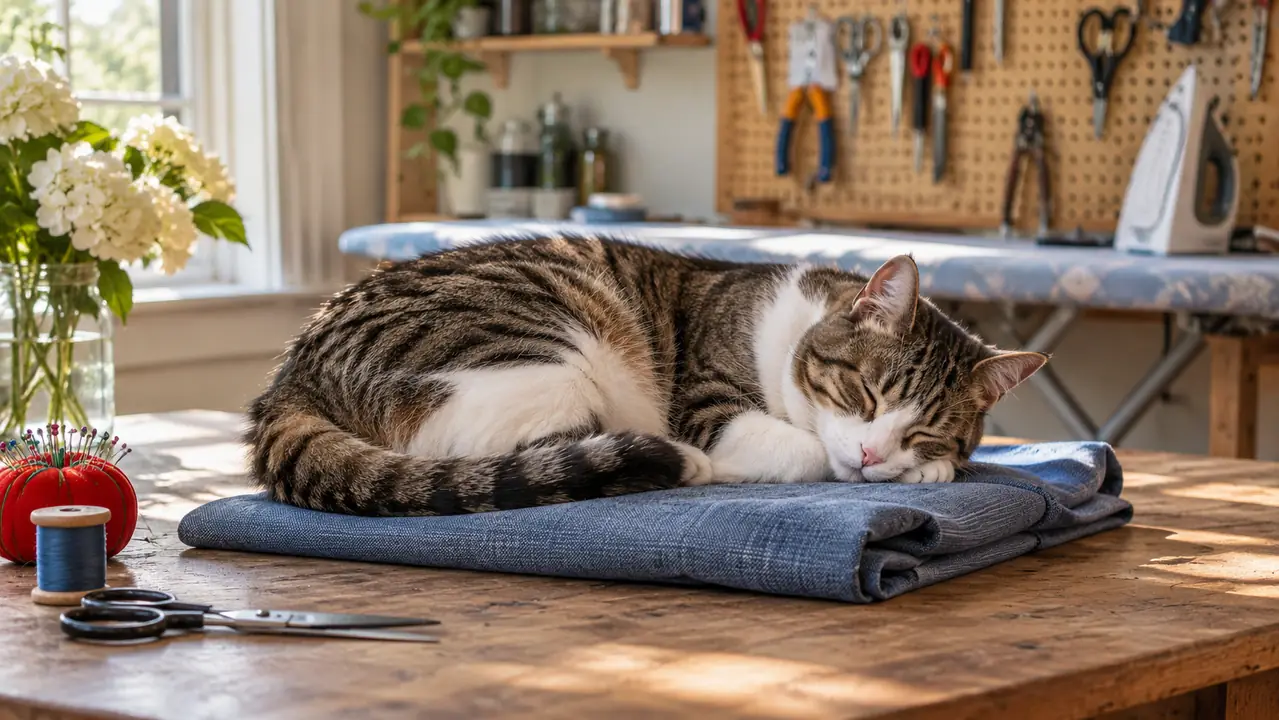
One practical note that has nothing to do with sewing and everything to do with my house. A hot iron with nowhere to go is a hazard, and a cat who sleeps on whatever fabric is laid out does not understand the word hot. The Solemate rest gives the oliso a home on the table, and it got me out of the habit of leaving the board up overnight. If you have a cat, a dog, or a grandchild who visits on Sundays, a designated rest is not a luxury, it is the difference between a good habit and a bad scare.
Pressing as you go only works if pressing is easier than not pressing. Forty-five seconds is the difference between the seam being pressed and the seam being skipped.
What the Mini Iron Will Not Do
It will not replace a full-size iron, and anyone who tells you otherwise is selling something. Give it a quilt back and you will press it in sections, chasing the fabric around the table, and it will take you three times as long as it should. Give it a stack of twelve pairs of trousers to finish and it will do the job, slowly, and you will be walking to the sink to refill it while the next pair waits.
It also will not hold heat through a long continuous run the way a heavy soleplate does. Small irons recover more slowly after a big press. If your work is production style, five identical shirts in a row, the big iron wins on stamina and it is not close. I notice this mainly on the days I batch the neighbors' alterations, and on those days the full-size iron comes out of the closet and stays out until the pile is finished.
And it is not a garment steamer. The steam is there on demand for pressing, and that is what it is good at. If you want to freshen a wool coat on a hanger under a cloud of steam, that is the big iron with a full tank, and no amount of wishing changes it. Buy the mini for the work at the needle, not for the work at the closet door.
Two Things to Check Before You Buy Either
Measure before you shop, and I mean the table, not the iron. Set a dinner plate down where you think the iron would live. If there is no such spot within reach of the needle, a mini iron will end up on the floor or at the far end of the board and you will have gained nothing but a smaller closet. The M2Pro is small, but small is not the same as free, and a tool you have to stand up to reach is a tool you will not reach for.
Second, look at what you actually sewed in the last three months, not what you plan to sew in January. If it was hems, patches, quilt blocks and a dress for a granddaughter, a mini iron covers nearly all of it and does it without a trip down the hall. If it was one big quilt with a wide backing plus a set of living room curtains, the full-size iron is doing the real work and the mini is a convenience. Neither answer is a criticism of your sewing.
And read the terms on whichever one you choose. The oliso carries a 3 year manufacturer warranty, which for a tool that lives on a table and gets knocked about is worth having in writing. Whatever full-size iron you are comparing it against, read its own paperwork rather than assuming, because warranties on irons vary a good deal more than people think. That is dull advice and it is the advice I give most often.
Who Should Buy Which
Buy the oliso M2Pro if your pressing happens at the machine. If you sew in a spare bedroom or a corner of a kitchen, if you are piecing quilts and pressing every seam as you go, if you make garments and want to press darts and curves without lugging anything across the room, or if you take a class and need something that runs on dual voltage 120/240, this is the sensible buy. It is also the right answer for hands that do better with a lighter tool and a shorter lift.
Keep or buy a full-size iron if your work is large and flat. If you press yardage and quilt backs and curtain panels, if you set creases in wool and want continuous steam, or if you press a batch of finished garments in one sitting, the big iron earns its shelf space. Most home sewists I know end up with both, and the split is simple: mini at the machine, big iron at the end of the board, and nobody has to choose a favorite.
If you truly only have room for one, be honest about the size of what you sew rather than the size of what you hope to sew. Small, frequent, detailed work goes to the mini every time, because the iron that is already hot is the iron that gets used. Big, occasional, flat work goes to the full-size, because you can only press a quilt back in sections for so long before your patience runs out. Answer that question truthfully and the choice makes itself.
The iron that gets used is the one within reach
Heats in 45 seconds, comes with its own silicone rest, and sits in a 10 by 5 inch footprint beside the needle. Check today's price and the current warranty terms on Amazon.
Amazon Check Today's Price on Amazon →